
UK Bathroom Renovation Cost Guide 2026: Real Budgets
Discover essential insights into UK bathroom renovation costs for 2026. Learn how to budget effectively and avoid hidden expenses.

A mid-range bathroom renovation in the UK typically costs fully fitted, in a moderate price range, though the full national range runs from a basic like-for-like refresh to a premium redesign costing significantly more. The single biggest cost trigger is moving the toilet. Rerouting the soil pipe adds £800–£2,500 to any project because it means cutting joists, potentially pulling up the floor below, and bringing in additional trades. Keep the toilet where it is and you avoid that bill entirely.
Here’s a quick-reference snapshot of typical all-in costs by bathroom type, with generally increasing costs from basic refreshes to premium wet rooms.
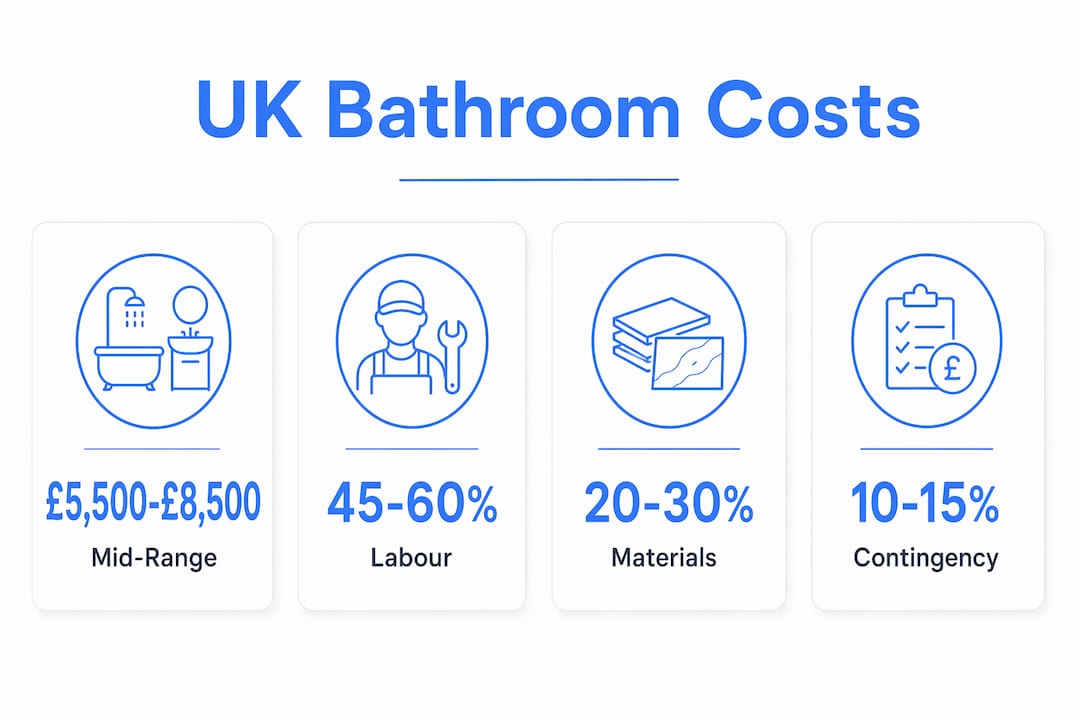
Pro Tip: Add a contingency of 10–15% on top of your headline budget before you sign anything. Strip-out almost always reveals something — a rotten subfloor, hidden pipework, or damaged joists — and that buffer is what keeps the project on track without a stressful renegotiation mid-job.
Table of Contents
- What do “budget,” “mid-range,” and “premium” actually mean?
- Where does the money actually go? A cost breakdown
- What drives the cost up, and what do homeowners miss?
- How to set a realistic budget and compare three quotes properly
- How long will a bathroom renovation take?
- How to save money without cutting corners
- Does a new bathroom add value to your home?
- A real JM Plumbing project: what it actually cost
- How to read a quote and spot red flags
- Key Takeaways
- What homeowners consistently get wrong about bathroom costs
- Ready to get a real quote for your bathroom in Cardiff or the Vale of Glamorgan?
- Useful sources
What do “budget,” “mid-range,” and “premium” actually mean?
The labels are everywhere, but they mean different things to different contractors. Here’s what each tier typically includes, ranging from budget to premium, with increasing specification and cost.
Regional pricing matters more than most guides admit. TradeMatch data shows a like-for-like refit ranges from roughly £4,200 in Sheffield to £14,800 in Inner London. London and the South East typically run 15–30% above the national mid-range, driven almost entirely by higher trade day rates rather than material costs.
The spec that sells in Cardiff won’t necessarily sell in Chelsea. A mid-range porcelain tile and a Roca suite is a strong finish in most of Wales and the Midlands. In prime London postcodes, buyers expect stone or large-format porcelain and a freestanding bath. Match your spec to your local market, not to Instagram.
Micro-scenarios to help you self-identify your tier:
- “I want a clean, functional bathroom for a rental property” — Budget tier, £3,000–£5,000, ceramic tiles, standard electric shower, no layout changes.
- “I want something I’m proud to show guests, with a walk-in shower” — Mid-range, £6,000–£9,000, porcelain tiles, thermostatic shower, quality suite.
- “I want a spa-feel wet room with underfloor heating” — Premium, £10,000–£15,000+, full tanking, linear drain, large-format tiles.
Where does the money actually go? A cost breakdown
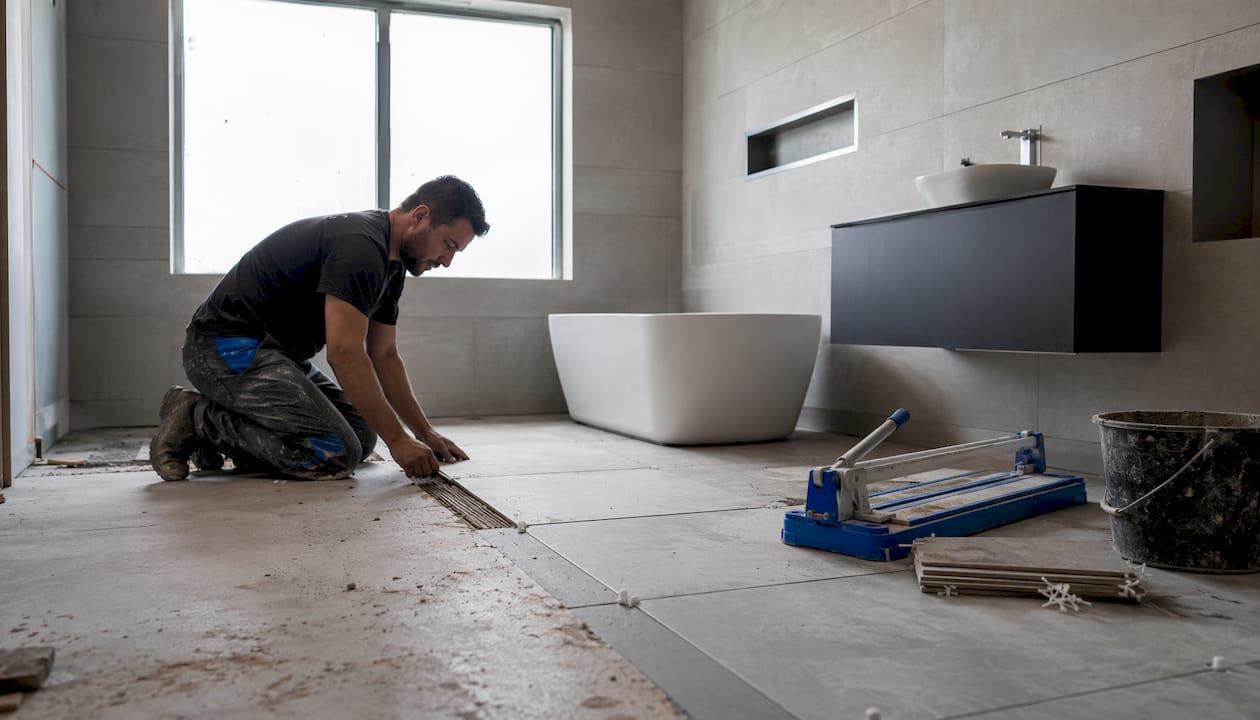
Labour typically accounts for a substantial proportion of a bathroom renovation’s total cost. That’s the number most homeowners don’t expect when they first price up a suite online and assume the rest is tiles and fittings. | Sanitaryware suite | £600–£2,500 | Toilet, basin, bath or shower tray, taps | | Tiling (materials) | £400–£1,500 | Ceramic to natural stone; see rates below | | Tiling (labour) | £600–£2,000 | £25–£60/sqm depending on tile type and complexity | | Plumbing and drainage | £500–£1,500 | First fix, waste runs, isolation valves | | Electrics and lighting | £300–£800 | Part P certified: extractor, shaver socket, shower circuit | | Waterproofing / tanking | — | Membrane, backer board, wet-area treatment | | Strip-out and disposal | £200–£500 | Skip hire, labourer time | | Flooring (non-tile) | — | LVT or vinyl if not tiling the floor | | Decorating and finishing | — | Painting, sealant, accessories |
Statistic to keep in mind: Labour at 45–60% of total means a £7,500 bathroom carries roughly £3,400–£4,500 in trade time before a single tile is bought.
Tiling choices move the needle fast. Standard ceramic tile labour runs £25–£35/sqm; large-format tiles jump to £35–£50/sqm; complex patterns reach £45–£60/sqm. On top of that, material costs range from roughly £15/sqm for basic ceramic to £100+/sqm for natural stone. A family bathroom with 16 sqm of tiled surface can swing £800–£2,500 on tile choice alone, before labour changes.
Pro Tip: Waterproofing and tanking should be the last thing you cut. Skipping a proper tanking membrane in wet areas is the most common reason tiles fail within three years — and the remedial cost of stripping out and re-doing the work far exceeds what you saved. Certified electrical work under Part P of the Building Regulations is equally non-negotiable.
What drives the cost up, and what do homeowners miss?
Layout changes are the primary lever. Moving the toilet is the most expensive single design decision you can make. It requires rerouting the soil pipe, cutting joists, and often accessing the floor or ceiling of the room below — which can pull in a structural check and an additional trade day. Keeping the toilet, bath, and basin in their existing positions is the single most effective way to control spend.
Primary cost drivers:
- Moving the toilet or soil pipe: adds £800–£2,500
- Plumbing reroutes (bath or basin relocation): adds £500–£1,500
- Full-height tiling vs. half-height splashback: adds £400–£900 in labour and materials
- Wet room conversion (floor fall, linear drain, full tanking): adds £1,500–£3,500
- Underfloor heating (electric mat): adds £600–£1,200
- Bespoke or designer sanitaryware: adds £1,000–£4,000+ over mid-range
- Structural work (joist strengthening, floor levelling): variable, often £300–£1,000
The hidden costs that catch people out are rarely glamorous. A water-damaged subfloor discovered during strip-out can add £200–£800 to replace. Outdated pipework in older properties often needs upgrading before new fittings can go in. VAT at 20% applies to most supply-and-fit contracts, and some low quotes arrive ex-VAT. Disposal charges, skip permits for road placement, and expedited lead times on special-order brassware are all line items that vanish from vague quotes.
Risk checklist before accepting a fixed-price quote:
- Has the contractor seen the room in person, not just photos?
- Does the quote include VAT explicitly?
- Is waste disposal and skip hire itemised?
- Is tanking and waterproofing a named line item?
- What happens if rot or hidden damage is found during strip-out?
- Are all electrical works Part P certified and included?
- Are lead times confirmed for any special-order items?
How to set a realistic budget and compare three quotes properly
Around 70% of homeowners underbudget for bathroom renovations, and roughly a quarter expect a full renovation for under £5,000. Getting three itemised quotes is the most effective protection against that gap.
Before you contact any contractor, prepare the following:
- Measure the room accurately (length, width, ceiling height).
- Photograph existing positions of toilet, basin, bath, and shower.
- Note where the soil pipe exits and whether it’s accessible.
- List your must-haves (walk-in shower, freestanding bath, underfloor heating) separately from your nice-to-haves.
- Record any known access issues: tight staircase for delivery, no parking, ground-floor room below the bathroom.
- Decide whether you want supply-only (you buy the sanitaryware) or supply-and-fit (contractor sources everything).
When the quotes arrive, compare them on these columns:
| Column | What to Check |
|---|---|
| Total price (inc. VAT) | Is VAT stated explicitly? |
| Supply vs. supply+fit | Who sources sanitaryware and tiles? |
| Labour / materials split | Labour should be 45–60% of total |
| Timescale | Working days on site, not calendar weeks |
| Warranty / guarantees | Workmanship warranty period stated? |
| Contingency provision | Is it included or caller-out separately? |
| Payment schedule | Linked to milestones, not arbitrary dates |
Professionals recommend at least three written, itemised quotes to compare like-for-like and avoid under-scoped low bids. The cheapest quote is often the one that omits tanking, disposal, or VAT — not the one with the most efficient contractor.
Pro Tip: Insist on a written payment schedule tied to project milestones: a deposit on start, a mid-point payment after first-fix plumbing and tiling, and the final balance only on completion and snagging sign-off. Never pay more than 25–30% upfront, regardless of how persuasive the pitch.
How long will a bathroom renovation take?
| Scope | Typical Duration | Key Sequencing Notes |
|---|---|---|
| Cloakroom refresh | 2–4 working days | Strip-out, plumbing, tiling, fittings |
| Standard family refit (no layout change) | 7–10 working days | Plumbing first fix, tanking, tiling, second fix |
| Full reconfiguration (layout change) | 9 working days | Structural checks, soil pipe reroute, extended plumbing |
| Wet room conversion | 10–15 working days | Floor fall, full tanking, specialist drainage, tiling |
| Premium four-piece with custom vanity | 15–20 working days | Bespoke lead times, extra carpentry, multi-trade overlap |
The sequence on site matters. Strip-out comes first, then first-fix plumbing and electrics, then tanking and backer board, then tiling, then second-fix plumbing and electrics, then fittings and finishing, then snagging. Each trade depends on the previous one finishing cleanly, so delays compound.
Household planning checklist:
- Arrange access to an alternative shower or bathroom for the full duration.
- Confirm working days vs. calendar days with your contractor (a 10-day job spans two calendar weeks with weekends).
- Check whether bespoke or special-order items are on site before work starts.
- Allow drying time for tanking membranes and adhesive before tiling begins (typically 24–48 hours per coat).
- Plan for noise and dust beyond the bathroom itself during strip-out.
Common delay causes: special-order sanitaryware with 4–6 week lead times, hidden rot discovered mid-strip, and waiting for Building Control inspection before covering drainage.
How to save money without cutting corners
The most impactful saving is also the simplest: keep the existing layout. A like-for-like refit avoids plumbing reroutes and saves £500–£1,500 on labour alone. After that, the savings stack up in the following order of impact:
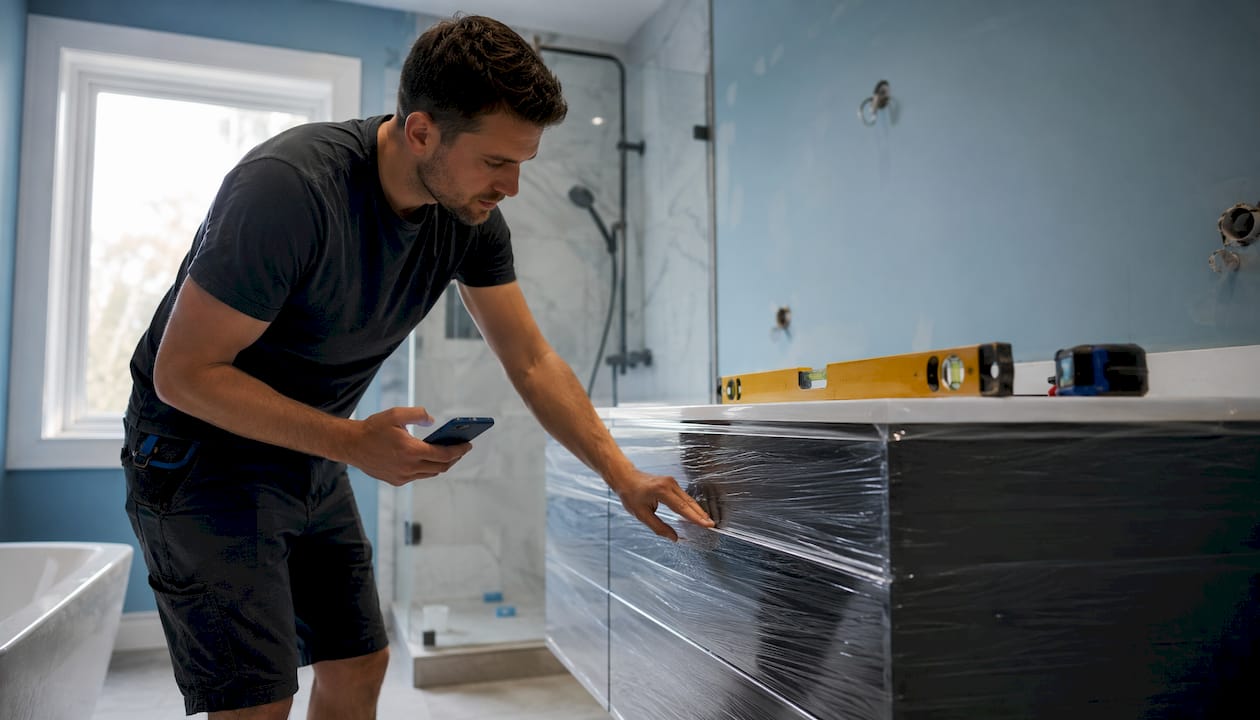
Choose standard-size tiles. Large-format tiles (600×1200mm and above) cost more per sqm in both materials and labour. A well-chosen 300×600mm porcelain in a neutral tone looks just as clean and costs significantly less to lay. Avoid full-height tiling when half-height gives adequate protection — in a family bathroom with a separate shower enclosure, tiling to 1.2m on the non-wet walls is perfectly sufficient and saves £400–£900.
Pre-fitted vanity units from trade suppliers (Roca, Ideal Standard, Tavistock) offer a polished look at a fraction of bespoke joinery costs. Supplier pack deals that bundle a toilet, basin, and bath from the same range often undercut buying items separately by 10–20%.
Phased scope is underused. If budget is tight, fit the core plumbing and tiling now and defer the heated towel rail, mirror, and lighting upgrades to a second visit. The structural and waterproofing work is the expensive part; finishing accessories can follow later without disrupting the trades.
Pro Tip: Buy your own mirrors, lighting, and accessories directly from a trade supplier or retailer. You save the contractor’s margin (typically 15–25%) on visible finishing items while keeping the trades fully accountable for the core works they supply and fit. Just confirm sizes and specifications with your contractor before ordering.
When not to cut costs: tanking and waterproofing, certified electrical work under Part P, structural repairs to joists or subfloors, and any work that requires Building Control sign-off. These are the items where a cheap shortcut creates a £2,000–£5,000 remedial bill two years later.
Does a new bathroom add value to your home?
A bathroom renovation usually adds a modest percentage to a UK property’s value, and homeowners recoup some proportion of their spend at sale, depending on specification and local market conditions. A mid-range bathroom renovation tends to add significant value, although it is not typically a direct profit. The real financial case is speed of sale and buyer confidence, not a direct pound-for-pound return.
The recoup rate drops when you over-spec for the local market. A £15,000 designer bathroom in a £200,000 terrace rarely returns its cost at sale because buyers in that price bracket aren’t paying a premium for stone tiles. Match the spec to what comparable properties in your street offer, and you’ll recoup closer to the upper end of that range.
Pro Tip: Before committing to a premium spec, check recently sold comparable properties in your area on Rightmove or Zoopla. If the top-selling homes nearby have mid-range bathrooms, a premium renovation is a lifestyle spend, not an investment. That’s a valid choice — just make it consciously.
A real JM Plumbing project: what it actually cost
This example is based on a representative standard family bathroom installation completed by Jmplumbingservicesltd in Cardiff: a 5.5 sqm room, like-for-like layout, mid-range spec with porcelain tiling and a thermostatic shower.
| Line Item | Cost |
|---|---|
| Plumber (5 days) | £1,500 |
Timescale: 9 working days on site. The project included a full supply-and-fit contract, a workmanship warranty, and a post-completion snagging visit. No layout changes were made, which kept plumbing costs contained and the timeline predictable.
Jmplumbingservicesltd covers Cardiff and the Vale of Glamorgan, including Penarth, Cowbridge, Dinas Powys, and Barry. Every project starts with a site visit and a written, itemised quote.
How to read a quote and spot red flags
A legitimate, well-scoped quote tells you exactly what you’re buying. Here’s what must appear on every written quote before you sign:
- Itemised labour and materials — separate line items for plumbing, tiling, electrics, and fitting, not a single lump sum.
- Scope limits — what is explicitly not included (e.g., plastering, floor levelling, structural repairs if discovered).
- VAT stated clearly — as a line item, not buried in a total.
- Start and estimated completion dates — in working days, not vague calendar references.
- Payment schedule — tied to defined milestones, not arbitrary dates.
- Workmanship warranty — period and what it covers, in writing.
- Contractor details — full company name, address, and trade registration or Federation of Master Builders (FMB) membership where applicable.
Red flags that should make you pause:
- Vague scope: “bathroom renovation, all in” with no line items.
- Large upfront deposit: more than 25–30% before work starts.
- No written contract or quote — verbal agreement only.
- Cash-only payment with no receipt or invoice.
- No trade references or verifiable previous work.
- Pressure to sign quickly or a “this week only” price.
- No mention of tanking, waste disposal, or VAT.
A contractor who can’t produce an itemised written quote is either inexperienced or planning to add costs later. Either way, move on to the next quote.
Key Takeaways
A mid-range UK bathroom renovation costs £5,500–£8,500 fully fitted, with labour accounting for 45–60% of the total and layout changes representing the single largest cost variable.
| Point | Details |
|---|---|
| Typical cost range | Mid-range family bathrooms run £5,500–£8,500; full national range is £3,000–£15,000+. |
| Biggest cost driver | Moving the toilet adds £800–£2,500; keeping the existing layout is the most effective saving. |
| Contingency to set | Reserve 10–15% above your headline budget for hidden discoveries during strip-out. |
| Get three quotes | Insist on itemised written quotes from at least three contractors to compare like-for-like. |
| Local installer | Jmplumbingservicesltd covers Cardiff and the Vale of Glamorgan with supply+fit contracts and written warranties. |
Immediate next steps:
- Measure your bathroom and photograph the existing layout, including soil pipe position.
- List your must-haves and nice-to-haves before contacting any contractor.
- Request at least three written, itemised quotes — each must include VAT, tanking, and disposal.
- Add your 10–15% contingency to the highest quote before setting your final budget.
- Contact Jmplumbingservicesltd for a local site visit and quote in Cardiff or the Vale of Glamorgan.
What homeowners consistently get wrong about bathroom costs
The conventional wisdom says “get three quotes and pick the middle one.” That’s not wrong, but it misses the real problem: most homeowners don’t know what to put in the brief before they ask for quotes. A vague brief produces vague quotes, and vague quotes produce disputes.
The gap between a £5,000 quote and a £8,500 quote for the same bathroom is almost never the contractor’s margin. It’s almost always what one contractor left out: tanking, disposal, VAT, or the contingency for what they’ll find behind the tiles. The homeowner who picks the £5,000 quote often ends up paying £8,000 anyway, just without the clarity of knowing it upfront.
Small bathrooms are a particular trap. They’re not proportionally cheaper. Labour time in a tight space is similar to a larger room because trade access is harder, tiling complexity increases around awkward corners, and there’s no room to stage materials. A 3 sqm en-suite can cost nearly as much per sqm as a 6 sqm family bathroom.
The best thing you can do before calling a single contractor is spend 20 minutes with a tape measure and a camera. Know your room, know your soil pipe position, and know whether you’re asking for a like-for-like refit or a layout change. That one hour of preparation is worth more than any amount of online research.
Ready to get a real quote for your bathroom in Cardiff or the Vale of Glamorgan?
Jmplumbingservicesltd offers something that most national comparison sites can’t: a contractor who will actually visit your property, assess what’s behind the walls, and give you a written, itemised quote before a penny changes hands.
Every project starts with a free site visit across Cardiff and the Vale of Glamorgan, including Penarth, Barry, Cowbridge, and Dinas Powys. The quote covers supply and fit, labour, tanking, certified electrical work, and a clear payment schedule tied to milestones. There are no vague lump sums and no surprise invoices mid-job.
Whether you’re planning a straightforward like-for-like refit or a full wet room conversion, the team at Jmplumbingservicesltd handles the full sequence: strip-out, first-fix plumbing, tanking, tiling, electrics, and finishing. All electrical work is Part P certified. Workmanship is backed by a written warranty.
Request your itemised quote today and get a realistic, line-by-line price for your project — no pressure, no obligation.
Useful sources
The figures and guidance in this article draw on the following authoritative references:
- Bathroom Renovation Cost UK: 2026 Price Guide — Hey Alfie: mid-range benchmark, contingency recommendation, soil pipe reroute costs, project durations, ROI figures, and the homeowner expectation gap data.
- Bathroom Renovation Cost UK 2026: £3,000–£15,000 — Pricing Penguin: labour share statistics (45–60%) and tiling labour/material rate breakdown.
- UK Bathroom Refit Cost 2026 — TradeMatch UK: regional price variation data (Sheffield to Inner London range).
- Bathroom Renovation Cost UK 2026 — Remodelers UK: overall all-in cost range validation (£3,000–£15,000+).
- Average Cost of a Bathroom Refit per m² — BestBuilders: three-quote recommendation and small bathroom cost-per-sqm insight.
- How Much Does a Bathroom Cost in 2026? — Kitchen Bathroom: regional cost table and fixture lifespan data.
- Full Bathroom Installation Costs UK — Squote: trade day rates, installation sequencing, and mid-range pricing walkthrough.