
Extractor Fan Not Working: Quick DIY Fixes for UK Homes
Is your extractor fan not working? Discover quick DIY fixes to check power, reset breakers, and get your fan running again!
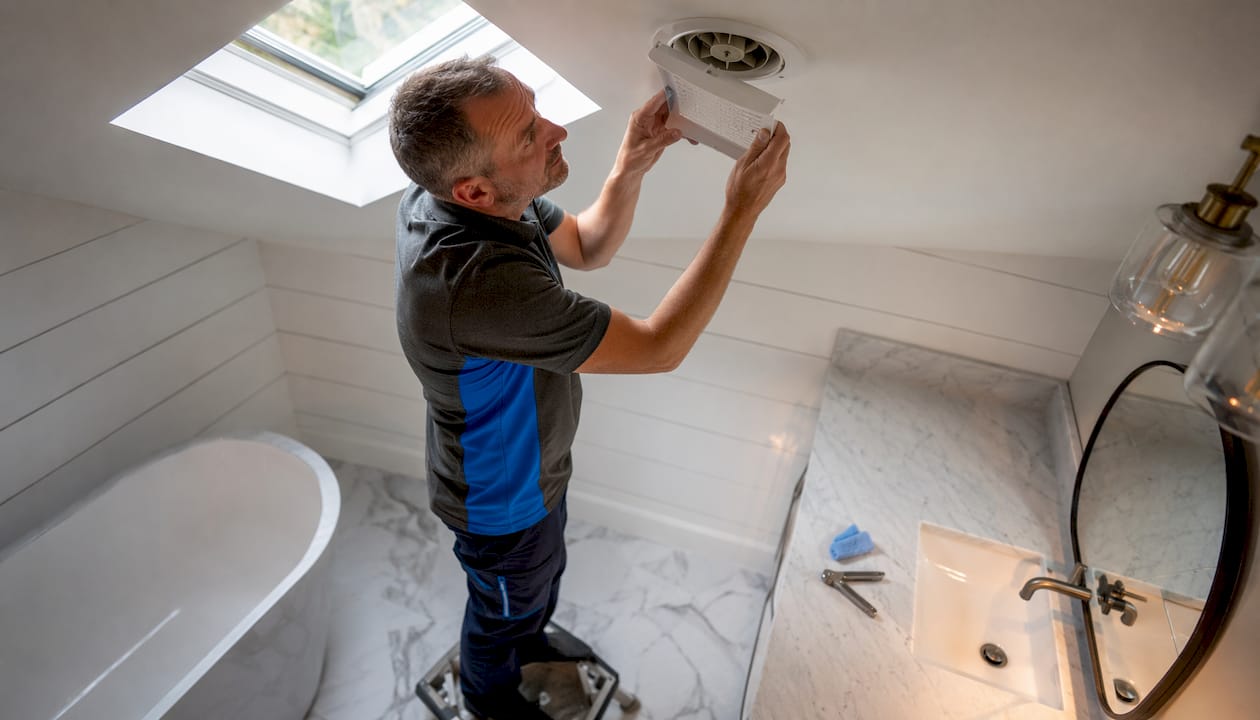
If your extractor fan has stopped working, start here: check the isolator switch, look at the consumer unit for a tripped breaker, and do a quick tissue test. Those three steps alone clear the majority of faults before you need to touch a screwdriver or call anyone out.
Before you go further, isolate power at the consumer unit before opening any cover or removing the grille. Never work on a live circuit.
Quick checks to run right now:
- Check the isolator switch (often a pull-cord in the ceiling or a switched fused connection unit outside the bathroom) — the isolator being off is the single most common cause of a “dead” fan
- Check the consumer unit for a tripped RCD or circuit breaker and reset it
- Hold a tissue near the grille with the fan running — if it doesn’t hold, extraction is failing
- Look outside at the external vent cap for obvious blockages (leaves, debris, seized flaps)
- Listen carefully: silence means no power; a hum means the motor is receiving power but not spinning
- Stop immediately if you smell burning or see any charring around the unit
Table of Contents
- 1. Safe diagnostic checks you can run before touching anything
- 2. How to read the symptoms and find the likely cause
- 3. Tools you’ll need for safe DIY checks and cleaning
- 4. Step-by-step fixes: start safe, escalate only if needed
- 5. Should you repair the fan or replace it?
- 6. A simple maintenance routine that prevents most failures
- 7. Safety rules, UK regulations, and when to hire an electrician
- Key Takeaways
- When a professional visit is the fastest answer
- Jmplumbingservicesltd: bathroom ventilation help in Cardiff and the Vale of Glamorgan
- Useful sources
1. Safe diagnostic checks you can run before touching anything
The tissue test is the standard first move: hold a sheet of tissue flat against the grille while the fan runs. If it sticks, air is moving. If it flutters weakly or falls, you have an airflow problem — either the motor is underperforming or something is blocking the duct. It takes ten seconds and tells you more than most visual checks.
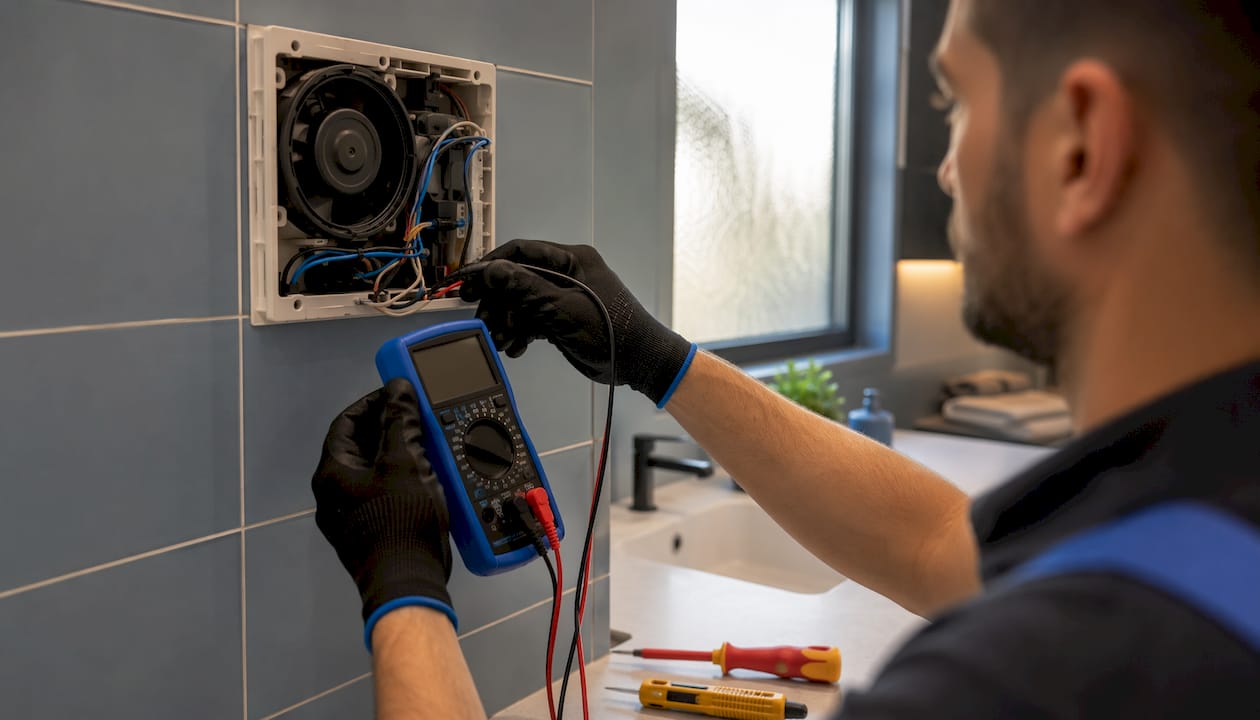
After the tissue test, work through the power supply in order. The isolator switch is the first place to look. In most UK bathrooms, this is either a ceiling pull-cord or a switched FCU (fused connection unit) mounted on the wall outside the bathroom door. Both can be accidentally knocked off, and FCU fuses do blow. Check the fuse inside the FCU with a small flat-head screwdriver — a blown fuse is a five-minute fix.
What each sound tells you:
- Silence with no response: no power is reaching the fan. Check isolator, FCU fuse, and consumer unit breaker before assuming the motor is dead.
- Humming without spinning: the motor is getting power but the impeller is seized or the starting capacitor has failed. Do not leave it running.
- Grinding or rattling: debris on the blades or worn bearings. Switch off and inspect.
- Normal sound, poor extraction: ducting or vent blockage. The fan itself may be fine.
Pro Tip: Check the pull-cord isolator and any switched FCU outside the bathroom first — these are frequently overlooked and account for a large share of “no power” call-outs that turn out to be nothing more than a tripped switch or a blown fuse.
Stop immediately if you smell burning. That is a motor overheating or a wiring fault, and the fan needs to be isolated at the consumer unit before anything else happens.
2. How to read the symptoms and find the likely cause
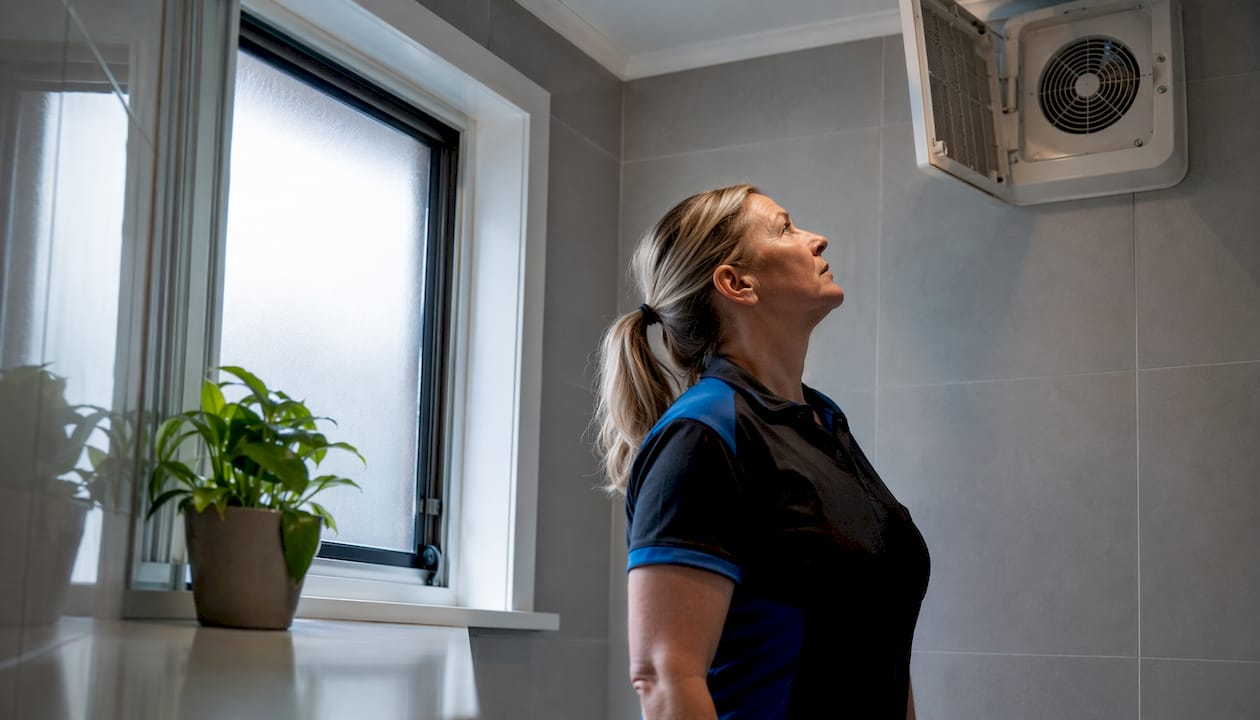
A quick look at what the fan is (or isn’t) doing usually points you toward the right fix category.
| Symptom | Likely cause | Risk level | Next step |
|---|---|---|---|
| Completely silent, no response | No power: isolator off, blown FCU fuse, tripped breaker | Low | Check isolator, FCU, consumer unit |
| Humming but not spinning | Seized impeller, failed capacitor, or motor fault | Medium | Isolate power; inspect impeller; call electrician if hum + smell |
| Running but poor extraction | Blocked duct, crushed flex, stuck damper, or blocked external vent | Medium (long-term moisture risk) | Inspect duct and external vent |
| Noisy/grinding | Worn bearings, debris on blades, loose mounting | Low–Medium | Clean blades; check mounting screws |
| Runs only with light on | Missing permanent live; timer/relay wiring fault | Low | Check wiring type; call electrician if timer model |
| Water dripping from unit | Condensation in duct or duct disconnected | Medium | Inspect duct insulation and connections |
| Persistent condensation/mold | Fan underperforming for some time | High (structural damage risk) | Full inspection; consider replacement |
A fan that runs but fails to extract is actually more dangerous long-term than one that is completely silent, because moisture damage accumulates unnoticed. Peeling paint, persistent condensation, and mold growth on walls or ceilings are signs the fan has been underperforming for a while, not just failing today.
Timer relay failure is a common fault in fans with overrun timers. It can cause the fan to stop running after the light goes off, or in some cases prevent it from running at all if the relay sits in the main power path. If your fan used to run on after you left the room and no longer does, the timer module is the first suspect.
3. Tools you’ll need for safe DIY checks and cleaning
You don’t need much. Most of the checks and cleaning steps in this guide require only basic household tools.
Basic tools:
- Flat-head and Phillips screwdriver set (for grille clips and FCU fuse)
- Torch or headlamp (ducting and loft spaces are dark)
- Step ladder or stable platform
- Vacuum cleaner with a brush attachment
- Soft cloths and warm soapy water
- Insulated gloves if you are handling anything near electrical connections
Consumables worth having:
- Aluminum foil tape (for sealing duct tears or loose joints — not standard cloth tape, which degrades)
- Replacement FCU fuse (13A or 3A depending on your unit)
- Replacement charcoal filter if your fan recirculates rather than extracts
What means stop:
A multimeter is useful for checking continuity and capacitor function, but only if you are confident using one on de-energized circuits. If any check requires you to open wiring connections, measure live voltage, or access the terminal block, stop and call a registered electrician. That boundary is not about skill — it is about UK law and safety.
Pro Tip: Take photos of the wiring and grille condition before you disassemble anything. If you end up calling a tradesperson, those photos cut diagnosis time significantly and often reduce the call-out cost.
4. Step-by-step fixes: start safe, escalate only if needed
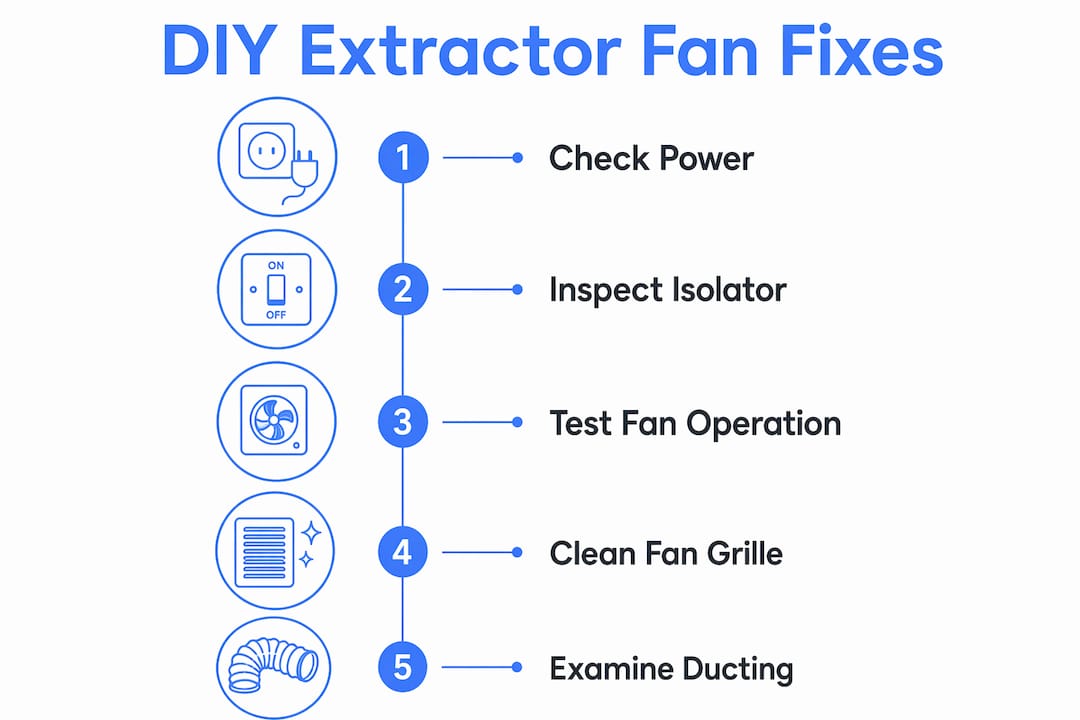
A stepwise approach — power first, cleanliness second, ducting third, then motor and electrical tests — resolves most faults without needing an electrician.
-
Isolate power. Turn off the fan circuit at the consumer unit. Confirm it is dead with a non-contact voltage tester if you have one.
-
Check the isolator and FCU fuse. Turn the isolator back on (or replace the FCU fuse) and restore power at the consumer unit. If the fan runs, you are done.
-
Remove the grille and clean. Most grilles clip off or have two small screws. Wash the grille in warm soapy water. Vacuum dust from the blades and motor housing. Cleaning metal grease filters and removing dust from impellers restores airflow in many fans. Charcoal filters cannot be washed — replace them.
-
Free a seized impeller. With power isolated, try turning the impeller by hand. It should spin freely. If it is stiff or stuck, remove any visible debris. Do not force it.
-
Run the tissue test. Restore power and hold a tissue to the grille. If it holds firmly, the fan is extracting. If not, move to the duct check.
-
Inspect the ducting and external vent. Trace the duct from the fan to the outside. Look for sagging, kinks, bird nests, or blocked external caps. Seal any tears with aluminum foil tape. Clear the external vent flap and check it opens freely.
-
Test the capacitor and motor continuity (qualified persons only). If the fan hums but won’t spin after cleaning, the start capacitor is the likely culprit. Testing requires a multimeter and a de-energized circuit. If you are not confident, this is the point to call an electrician.
-
Isolate and call an electrician if you see any of these: burning smell, charring on wires or housing, persistent RCD trips after reset, or a motor that hums and gets warm. Do not attempt to continue.
What to photograph and note before calling a tradesperson:
- The wiring layout inside the fan housing (before disconnecting anything)
- The grille and any visible dust or damage
- The external vent condition
- The fan model number (usually on a label inside the housing)
- Whether the fan has a timer, humidistat, or runs with the light
Pro Tip: Bridging the switched live to the permanent live to isolate a failed timer relay is a valid diagnostic step — but it is for qualified persons only. If your fan stopped overrunning after the light goes off, mention this specifically when you call an electrician, as it points directly to the timer module.
5. Should you repair the fan or replace it?
Age is the clearest guide. A fan over ten years old that develops a motor fault is rarely worth repairing — replacement parts are often unavailable, and a new unit with a current IP rating and extract rate will outperform the old one from day one.
Replace rather than repair when:
- The motor hums, overheats, or shows signs of burning
- The fan has tripped the RCD more than once
- Persistent condensation or mold continues despite cleaning and duct checks
- The unit is over ten years old and has had repeated faults
- Repair cost approaches or exceeds the price of a new unit
Repair is reasonable when:
- The fault is a blown FCU fuse, a tripped breaker, or a dirty impeller
- The ducting is blocked or disconnected but the motor is sound
- The fan is relatively new and the fault is clearly mechanical (debris, loose mounting)
When requesting a quote for replacement, have the fan’s extract rate (in litres per second), its IP rating, and the duct diameter ready. UK bathrooms need to meet the ventilation requirements set out in Approved Document F — a replacement unit must match or exceed the original specification.
Pro Tip: If you are already planning a bathroom renovation, replacing the extractor fan at the same time saves a separate call-out and lets you upgrade to a quieter, more efficient unit with a proper IP65 rating for wet zones. Check signs that a full renovation makes sense before committing to a repair-only approach.
6. A simple maintenance routine that prevents most failures
Most extractor fan failures are preventable. Dust and grease build-up on blades and grilles is the leading cause of reduced airflow, and blocked external vents are the second.
Quarterly tasks:
- Remove and wash the grille in warm soapy water
- Vacuum the fan blades and motor housing with a brush attachment
- Check the external vent flap opens and closes freely
- Run the tissue test to confirm extraction is still working
Annual tasks:
- Inspect the full duct run for sagging, kinks, or loose joints
- Replace charcoal filters on recirculating fans (non-washable)
- Check the isolator switch and FCU fuse are functioning
- Wipe down the interior housing and check for any moisture ingress or rust
A simple maintenance log keeps this manageable. A note in your phone or a sticky label inside the grille with the last service date is enough. Regular checks extend motor life, reduce the chance of mold damage, and mean you catch a blocked duct before it causes a problem rather than after.
7. Safety rules, UK regulations, and when to hire an electrician
Non-negotiable safety rules:
- Always isolate the fan circuit at the consumer unit before removing covers or touching internal components
- Never touch wiring connections unless you are a qualified electrician
- Stop immediately if you smell burning, see charring, or the RCD trips repeatedly
UK regulatory context:
Bathroom electrical work falls under Part P of the Building Regulations in England and Wales. Any new wiring or replacement of a fan that involves wiring changes must be carried out by a registered electrician who can self-certify the work, or notified to your local authority building control. Fans in bathroom zones also need to meet the IP rating requirements for their location — a unit in Zone 1 (directly above a bath or shower) needs at least IP44; Zone 2 requires IP44 as a minimum. Approved Document F sets the minimum extract rates for bathrooms and kitchens.
Fans with humidistats or timers require both a permanent live and a switched live. Incorrect wiring when replacing units is a common cause of fans that run only with the light or fail to overrun as intended. If you are replacing a basic fan with a timer or humidistat model, the wiring almost certainly needs updating.
Call a qualified electrician when:
- The motor hums and smells of burning
- The RCD trips when the fan runs
- Any wiring work is needed (new cable, terminal connections, replacing a timer model)
- You need a capacitor replaced and are not confident with a multimeter
- The fan is in a wet zone and needs IP-rating verification after replacement
For guidance on choosing a qualified electrician and checking credentials, the UK electrician selection guide from Priory Electrical covers what to look for.
Pro Tip: After any fan replacement, ask the electrician for a minor works certificate or an Electrical Installation Certificate. This matters for insurance, for building regulations compliance, and if you ever sell the property.
This article is general guidance, not professional electrical or legal advice. For your specific situation, confirm current regulations with a registered electrician or your local authority building control.
Key Takeaways
Most extractor fan faults resolve with a power check, a clean, and a duct inspection — only a minority genuinely need an electrician or a replacement unit.
| Point | Details |
|---|---|
| Check power first | Isolator switch, FCU fuse, and consumer unit breaker resolve the majority of “dead fan” faults. |
| Use the tissue test | Hold a tissue to the grille to confirm whether air is actually moving before assuming a motor fault. |
| Hum plus smell means stop | A humming motor with a burning smell is an urgent isolation case — do not leave it running. |
| Running fans can still fail | A fan that runs but doesn’t extract causes hidden moisture damage; inspect the duct and external vent. |
| Jmplumbingservicesltd | For Cardiff and Vale of Glamorgan homeowners, Jmplumbingservicesltd handles fan replacement, duct repairs, and full bathroom ventilation upgrades with IP-rated components and compliant installation. |
When a professional visit is the fastest answer
The honest truth about extractor fan faults: the DIY checks in this guide will resolve a lot of them. A tripped breaker, a blocked vent, a dusty impeller — these are genuinely fixable in an afternoon. But the faults that look simple from the outside often aren’t. A fan that hums, a timer that stopped working, a unit that keeps tripping the RCD — these point to motor failure, wiring issues, or a capacitor fault, and none of those are safe to diagnose without proper tools and training.
What a site visit actually delivers is speed. A qualified tradesperson with the right equipment can test continuity, check capacitor function, and identify a wiring fault in the time it takes most homeowners to find the right YouTube video. And when the diagnosis is “replace the unit,” having someone who knows the IP rating requirements and can certify the work properly means you don’t have a compliance problem when you come to sell.
… After any replacement, the installation is tested, the IP rating is confirmed for the zone, and the paperwork is in order.
Jmplumbingservicesltd: bathroom ventilation help in Cardiff and the Vale of Glamorgan
When the DIY checks point to a motor fault, a wiring issue, or a fan that simply needs replacing, Jmplumbingservicesltd offers a faster path than sourcing parts and waiting for a separate electrician. The team covers Cardiff and the Vale of Glamorgan and handles the full scope of bathroom ventilation work as part of its bathroom installation and renovation services.
What a visit covers:
- Safety isolation and full fan diagnosis
- Fan replacement with IP-rated units matched to the bathroom zone
- Ducting inspection, repair, and replacement where needed
- Full bathroom ventilation audits for persistent condensation or mold problems
- Compliant installation with certification where required
Whether you need a straightforward fan swap in Penarth, a ventilation upgrade as part of a bathroom renovation in Cardiff, or a diagnosis visit in Barry or Cowbridge, the process is the same: clear quote upfront, compliant installation, and no loose ends on the paperwork. Get in touch via the Jmplumbingservicesltd contact page to describe your symptoms and arrange a visit.
Useful sources
“Trade guidance recommends homeowners limit DIY to cleaning and external visual checks; any test that requires access to live wiring or measuring voltage should be done by a qualified electrician.” — Elec-Mate Extractor Fan Troubleshooting Guide
- Elec-Mate: Extractor Fan Not Working — Detailed troubleshooting guide covering isolator checks, timer relay faults, and motor diagnosis; one of the most thorough UK-focused resources available.
- Checkatrade: Bathroom Fan Not Working — Practical homeowner guide including the tissue test and common fault causes.
- ServiceTeam: Fan Working But Not Extracting — Focused specifically on the “running but not extracting” fault, covering duct and damper issues.
- Family Handyman: Common Bath Fan Problems — US-based but widely cited for its stepwise troubleshooting methodology; power first, then cleanliness, then ducting.
- Northampton Appliance Repairs: DIY Troubleshooting Guide — Covers cleaning steps, duct inspection, and aluminum tape repairs in practical detail.
- Bless Construction: Bathroom Extractor Fan Not Working — Useful for understanding long-term symptoms (condensation, mold, peeling paint) as indicators of chronic underperformance.
- GOV.UK: Approved Document F (Ventilation) — The primary UK regulatory reference for minimum extract rates and ventilation requirements in dwellings. Consult this (or a registered electrician) for replacement specifications.
For IP rating requirements and Part P compliance, always confirm current rules with a registered electrician or your local authority building control — regulations are updated periodically.