
Power Shower vs Electric: Which One Suits Your Home?
Discover the key differences in the power shower vs electric debate. Find out which shower fits your home’s plumbing needs best!
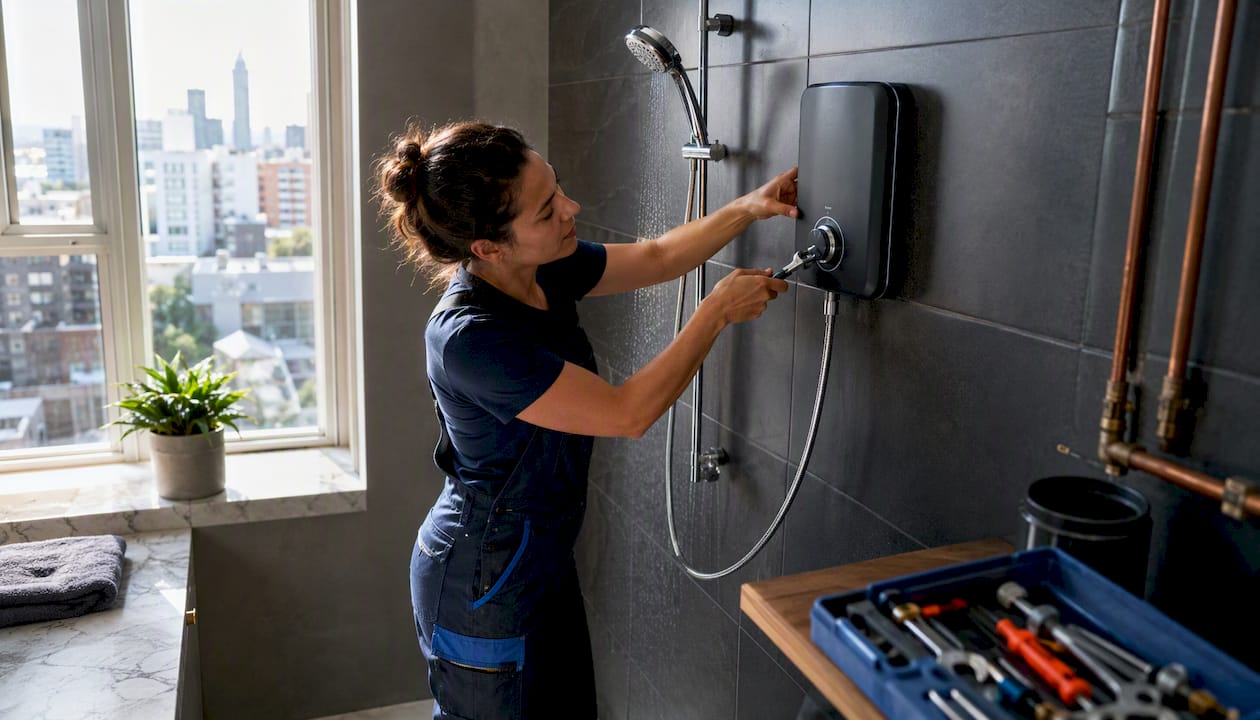
For most UK homes, the answer comes down to plumbing, not preference. If you have a gravity-fed system with a cold tank in the loft and a hot-water cylinder, a power shower gives you the pressure boost you’re looking for. If you’re on a combi boiler or mains-pressure system, an electric shower is the practical, independent choice.
Quick eligibility check:
- Do you have a hot-water cylinder and a cold tank in the loft? A power shower can work.
- Are you on a combi boiler or mains-pressurized system? Go electric.
- Do you have a spare high-amp circuit or room to run one? Electric showers need it.
Power showers typically deliver a significantly higher flow rate per minute than electric showers, providing a noticeably stronger water pressure. That gap is the single most important number in this comparison, and everything else flows from it. JM Plumbing Services handles both types across Cardiff and the Vale of Glamorgan, and the team’s first question on every site visit is always the same: what plumbing system do you have?
Table of Contents
- What is a power shower and how does it work?
- What is an electric shower and how does it work?
- How do the two shower types compare head to head?
- What do power and electric showers actually cost to run?
- What are the installation and UK safety requirements?
- Which shower should you choose for your bathroom?
- How long do they last and what maintenance do they need?
- How we estimated flow rates, water use, and running costs
- The installer’s honest take on this decision
- JM Plumbing Services handles the whole decision for you
- Key Takeaways
- Useful sources and further reading
What is a power shower and how does it work?
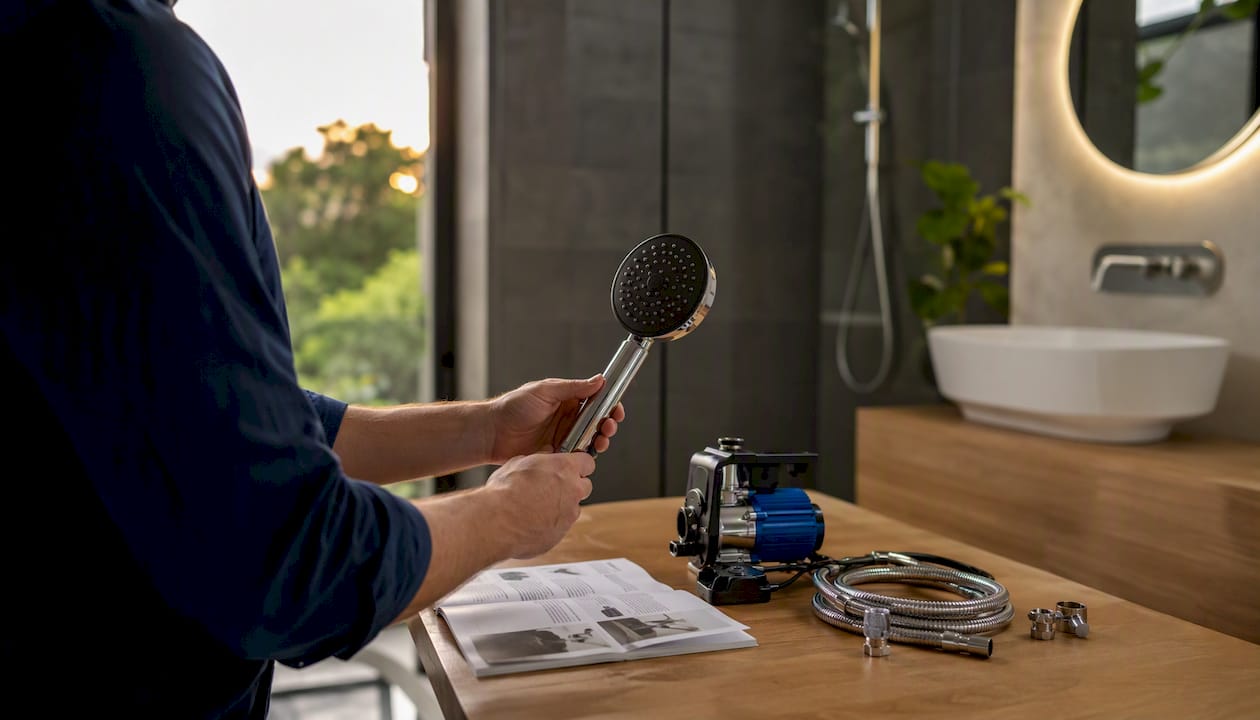
A power shower is a mixer shower with a built-in pump. It draws hot water from your stored cylinder and cold water from your tank, blends them to temperature, then pushes the mix through the head at boosted pressure. The pump is the key component; without it, the shower is just a standard mixer.
What your plumbing needs to support one:
- A gravity-fed cold-water tank, usually in the loft
- A separate hot-water cylinder, typically in an airing cupboard
- Adequate tank capacity to sustain the higher flow rate
- Low natural water pressure (the scenario where a pump actually adds value)
Power showers are incompatible with combi boilers and mains-pressurized unvented systems because those systems already deliver water at mains pressure. Fitting a pump on top of mains pressure can damage pipework and void warranties.
Flow rate in practice: At 12–18 L/min, a power shower feels noticeably different from a gravity-fed mixer running at 6–8 L/min. The difference is roughly the gap between a drizzle and a proper rain shower.
The tradeoff is water consumption. Longer or higher-flow showers use more water, which may impact your water bill and how quickly your hot water cylinder empties. That matters both for your water bill (if metered) and for how quickly your cylinder empties. If you have a small cylinder and a household of four, back-to-back power showers will drain it fast.
Pro Tip: Before ordering a power shower, check your cylinder’s capacity. A standard hot water cylinder of typical size may empty within several minutes at high flow rates, so household shower usage patterns are an important consideration. If your household showers consecutively, a larger cylinder or a twin-impeller pump with a slower flow setting may be worth the extra cost.
What is an electric shower and how does it work?
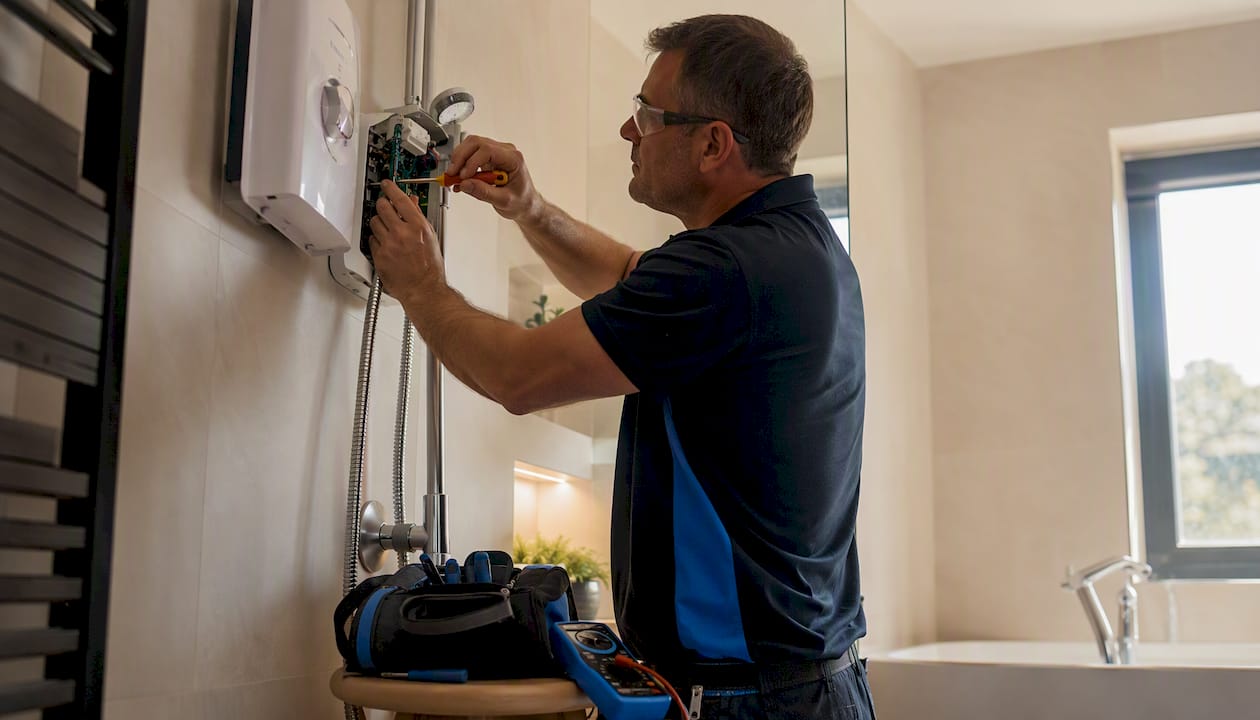
An electric shower is a self-contained unit that takes cold water straight from the mains and heats it on demand using an internal heating element. There’s no cylinder, no stored hot water, and no boiler involvement. Turn it on and it heats; turn it off and it stops.
What your home needs to support one:
- Cold mains water supply (virtually universal in UK homes)
- A dedicated high-amp electrical circuit from the consumer unit
- An RCD-protected circuit compliant with BS 7671 and Part P of the Building Regulations
- Sufficient consumer unit capacity for the additional circuit
The kW rating of the unit directly controls the flow rate and temperature. A 7.5 kW shower at 6–8 L/min will feel noticeably weaker than a 10.5 kW model, especially in winter when incoming cold water is colder and the element has to work harder. Higher kW means more flow and better temperature stability, but it also means a heavier electrical load.
Electric showers heat only the water you actually use, which avoids the standing heat losses that come with a stored cylinder. That’s a genuine efficiency advantage, though the electricity tariff you’re on determines whether it translates into lower bills.
Key electric shower facts:
- Typical flow rate: 6–8 L/min (lower than a power shower, but adequate for most users)
- kW range: 7.5 kW to 10.5 kW for most domestic units
- Independent of boiler: works even if your boiler breaks down
- Running cost: a 7.5 kW unit running for 10 minutes uses 1.25 kWh of electricity
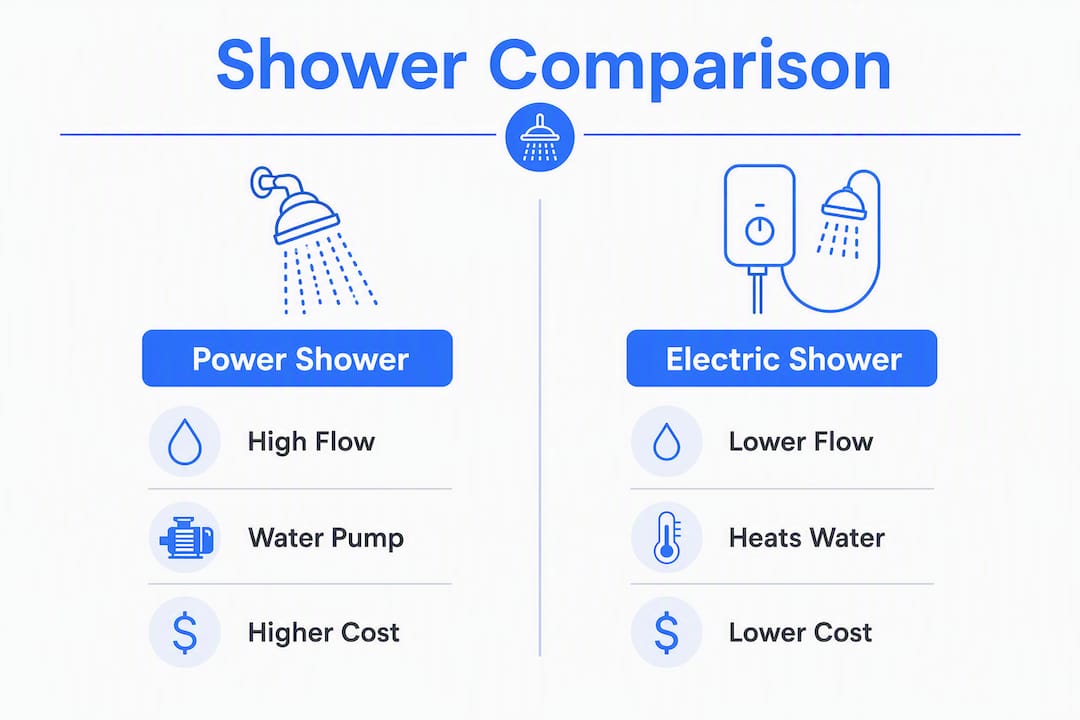
How do the two shower types compare head to head?
The table below covers the dimensions that actually matter when you’re making a buying decision.
| Dimension | Power Shower | Electric Shower |
|---|---|---|
| Flow rate | 12–18 L/min | 6–8 L/min |
| Energy source | Stored hot water (gas boiler or immersion) + pump motor | Mains electricity only |
| Water usage (10 min) | ~150 L at 15 L/min | — |
| Plumbing compatibility | Gravity-fed cylinder + cold tank only | Any home with cold mains supply |
| Installation complexity | Higher: pump, plumbing connections, fused connection unit | Moderate: dedicated high-amp circuit, cable routing |
| Typical purchase cost | Higher (pump adds cost) | Lower |
| Typical install cost | Higher (plumbing-heavy) | Moderate (electrical-heavy) |
| Boiler independence | No: needs stored hot water | Yes: fully independent |
| UK safety requirements | Standard plumbing regs | Part P / BS 7671, qualified electrician |
| Lifespan (typical) | 5–10 years | 5–10 years |
Electric showers are generally cheaper to buy and install than power showers, largely because the pump and associated plumbing work push the power shower’s total cost up.
Which home scenario favors each type:
- Gravity-fed older property with low pressure and a loft tank: power shower is the natural fit
- Flat or newer build on a combi boiler: electric shower is the only viable option
- Home where the boiler fails regularly: electric shower provides a reliable backup
- Household prioritizing a spa-like flow rate: power shower, provided the plumbing supports it
- Metered water supply with a small household: electric shower uses less water per shower
What do power and electric showers actually cost to run?
Purchase and installation price ranges
Electric showers typically cost less to buy outright, with basic units starting around £60–£80 and mid-range models with higher kW ratings sitting in the £150–£300 range. Installation adds roughly £150–£300 depending on how far the consumer unit is from the bathroom and whether new cable routes are needed. For a full bathroom renovation cost picture, those figures sit within a broader project budget.
Power showers start around £150 and can reach £400–£600 for quality branded units. Installation is more expensive because it involves both plumbing connections to the cylinder and cold tank, and the electrical connection for the pump motor. Budget £200–£400 for a straightforward install; more if pipework needs rerouting.
Worked 10-minute running cost examples
A typical electric shower running for a short duration uses a measurable amount of electricity, the cost of which depends on your electricity tariff.. Here’s the math:
- Energy used: 7.5 kW × (10 ÷ 60) hours = 1.25 kWh
- Cost: 1.25 kWh × £0.12 = £0.15 per shower
A power shower at 15 L/min uses roughly 150 litres in the same 10 minutes. The cost of that water depends entirely on how it was heated:
- Gas boiler heating: gas is typically cheaper per kWh than electricity, so the marginal cost of 150 litres of hot water from a gas-heated cylinder is often lower than the electric shower’s 15p
- Electric immersion heater: the cost rises significantly, potentially making the power shower more expensive per shower than the electric unit
When hot water comes from a gas boiler, a power shower’s higher water consumption can still be cheaper to run than an electric shower because the fuel cost per kWh is lower. Flip to an electric immersion and that advantage disappears.
Pro Tip: If you’re on a time-of-use electricity tariff (like Octopus Go), running an electric shower during off-peak hours can cut the per-shower cost significantly. Power showers don’t offer that flexibility because the cylinder needs to be pre-heated.
Assumptions used in these examples: electricity at 12p/kWh, gas at approximately 3–4p/kWh, flow rate of 15 L/min for the power shower, 7.5 kW unit for the electric shower. Actual tariffs vary; check your bill for your current unit rate.
What are the installation and UK safety requirements?
Who does what on the job
A power shower install typically needs a plumber for the water connections and may need an electrician for the pump’s fused connection unit. An electric shower install almost always needs a qualified electrician for the dedicated circuit, and a plumber for the water supply connection. On many jobs, both trades are on site.
Electric shower electrical requirements
Electric showers require a dedicated high-amp electrical supply, and all electrical work must be completed by a qualified electrician to meet UK regulations. Specifically:
- A dedicated circuit from the consumer unit (not shared with other appliances)
- Correctly sized cable for the unit’s kW rating (typically 6mm² or 10mm² twin-and-earth)
- RCD protection on the circuit
- Compliance with BS 7671 (the IET Wiring Regulations) and notification under Part P of the Building Regulations for notifiable electrical work in a bathroom
Retrofitting this circuit can be the most disruptive part of the job if the consumer unit is far from the bathroom. Cable routes through floors, walls, or ceiling voids add time and cost.
Power shower plumbing compatibility
Power showers need a gravity-fed system. If your home has a combi boiler, a mains-pressurized unvented cylinder, or any system that delivers water at mains pressure, a power shower will not work and should not be fitted. The pump is designed to boost low-pressure gravity-fed water; applying it to mains pressure can damage the unit and the pipework.
Red flags to watch for when getting quotes:
- Any installer who proposes connecting a power shower pump directly to a mains supply
- Quotes that don’t mention checking your existing cylinder capacity
- Electric shower quotes that don’t include a dedicated circuit (sharing an existing circuit is non-compliant)
- No mention of Part P notification or a registered electrician for electric shower work
Pro Tip: Ask any installer whether they’ll be notifying the work under Part P or whether they hold a competent person scheme registration (such as NICEIC or NAPIT for electrical work). A yes to either is the right answer. A blank look is a red flag.
Which shower should you choose for your bathroom?
Work through these steps before you order anything, including choosing the best bathroom doors for your Dallas home to complement your renovation.
-
Identify your plumbing system. Go to your airing cupboard. If there’s a hot-water cylinder there, and a cold-water tank in the loft, you’re on a gravity-fed system. If your boiler heats water on demand with no cylinder, you’re on a combi. Check the boiler casing if you’re unsure; it will say “combination” or “combi” on the label.
-
Test your mains pressure. Fill a one-litre jug from the cold tap in the kitchen. If it fills in under 6 seconds, your mains pressure is reasonable. If it takes longer, pressure may be low, but that’s a separate issue from which shower type you need.
-
Check your consumer unit. Open the fuse box cover and count the spare slots. An electric shower needs a dedicated circuit; if the board is full, a consumer unit upgrade may be needed before installation. Ask an electrician to assess capacity before you buy the shower unit.
-
Apply the decision rule:
- Gravity-fed cylinder + cold tank: a power shower is compatible; consider one if pressure is low
- Combi boiler or mains-pressurized system: electric shower is the correct choice
- Unsure about your system: book a site assessment before ordering
-
Check product specs against your system. Flow-rate ranges in guides are typical figures; always verify the manufacturer’s spec sheet for the specific unit you’re buying before committing.
Signs you should book a site visit rather than order online:
- You can’t identify whether you have a cylinder or a combi
- Your consumer unit looks old or already has every slot occupied
- The bathroom is far from the consumer unit and you’re unsure about cable routes
- You’re in a flat where the plumbing layout isn’t clear
Pro Tip: Some power shower models carry Quiet Mark accreditation for reduced pump noise. If the bathroom is adjacent to a bedroom, that’s worth checking on the spec sheet before you buy.
How long do they last and what maintenance do they need?
Both shower types typically last 5–10 years, though quality of installation and local water hardness have a bigger effect on lifespan than the type itself.
Power shower maintenance:
- Pump seals and impeller wear over time; a grinding or reduced-flow symptom usually signals pump wear
- The stored-water system (cylinder, tank) needs periodic checks for scale and corrosion
- Showerhead and hose limescale buildup is more pronounced at higher flow rates
- Regular descaling of the head (monthly in hard-water areas) extends the head’s life significantly
Electric shower maintenance:
- The heating element accumulates limescale in hard-water areas, which reduces efficiency and eventually causes failure
- Thermostatic cartridges wear and may need replacement after several years
- Solenoid valves can stick or fail, causing temperature fluctuations
Hard water is the main enemy of both types. In areas like Cardiff, where water hardness is moderate, descaling the showerhead every 4–6 weeks and fitting an inline scale inhibitor on the supply pipe can meaningfully extend the unit’s life. For an accessible bathroom design where thermostatic control matters, electric showers with thermostatic cartridges are worth the extra maintenance attention.
Pro Tip: For electric showers in hard-water areas, a magnetic scale inhibitor fitted to the cold supply pipe costs under £30 and can add years to the heating element’s life. It’s one of the cheapest maintenance investments available.
How we estimated flow rates, water use, and running costs
The figures in this article come from a small set of authoritative UK trade and retail sources, combined with straightforward arithmetic. Here’s the methodology.
Sources used
- Flow-rate ranges (12–18 L/min for power showers; 6–8 L/min for electric showers): Bathroom Mountain’s comparison guide
Step-by-step calculations
Electric shower (10-minute example):
- kWh used = kW rating × hours = 7.5 × (10 ÷ 60) = 1.25 kWh
- Cost = 1.25 kWh × £0.12/kWh = £0.15
Power shower water volume (10-minute example):
- Volume = flow rate × minutes = 15 L/min × 10 = 150 litres
Assumptions and sensitivity
| Assumption | Value used | Sensitivity note |
|---|---|---|
| Electricity unit price | 12p/kWh | At higher electricity rates, the 10-minute cost rises accordingly |
| Electric shower kW | 7.5 kW | — |
| Power shower flow rate | 15 L/min | — |
| Gas heating cost | ~3–4p/kWh | Varies by tariff; check your bill |
The 12p/kWh figure is used here as a conservative baseline for illustration. Actual electricity prices in the UK have varied significantly; always use your own bill’s unit rate for a precise calculation.
Note: These are estimates for comparison purposes. Manufacturer specs, local water temperature, and your specific tariff will all affect real-world results. Ask your installer for a site-specific assessment.
The installer’s honest take on this decision
The most common mistake JM Plumbing Services sees is homeowners ordering a power shower for a home that has a combi boiler. It happens regularly, and it always results in either a return of the unit or an expensive workaround. The plumbing system decides the choice; the shower preference comes second.
When the team assesses a bathroom, the first check is always the airing cupboard and the loft. A cylinder and a cold tank mean a power shower is on the table. No cylinder means it isn’t, full stop. From there, the conversation shifts to pressure, flow preference, and budget.
For gravity-fed homes with genuinely low pressure, a pumped mixer or a built-in power shower both work, but a pumped mixer with a separate pump unit gives more flexibility if the pump needs replacing later. Built-in power showers are tidier but the whole unit needs replacing if the pump fails.
If you’re unsure about your plumbing or electrical setup, a pre-install assessment is the right first step. Getting it wrong costs more than the assessment ever would.
JM Plumbing Services handles the whole decision for you
Choosing between a power shower and an electric shower is straightforward once you know your plumbing system. Getting to that answer on your own, especially in an older Cardiff terrace or a Vale of Glamorgan property with mixed plumbing, is where things get complicated.
Jmplumbingservicesltd covers Cardiff, Penarth, Cowbridge, and Rhoose with end-to-end bathroom installation and renovation services. The team handles plumbing and electrical coordination on the same job, which means one point of contact instead of two separate trades. Every install is compliant with Part P and BS 7671, and the work is warranty-backed.
For Penarth homeowners, bathroom installation and renovation in Penarth includes a pre-install assessment that covers system compatibility, electrical capacity, and a fixed-price quote before any work starts. The same applies in Cowbridge and across Cardiff with the bathroom fitters Cardiff service for clients who already have a unit and need a compliant, professional fit.
Get in touch to book a site assessment and get a local quote before you order anything.
Key Takeaways
Your plumbing system determines which shower type you can install; everything else is secondary.
| Point | Details |
|---|---|
| Plumbing decides the choice | Gravity-fed cylinder = power shower compatible; combi boiler = electric shower only. |
| Flow rate gap is significant | Power showers deliver 12–18 L/min; electric showers deliver 6–8 L/min. |
| Running costs depend on fuel | A 7.5 kW electric shower costs ~15p per 10-minute shower at 12p/kWh; power shower cost depends on whether hot water is gas or electrically heated. |
| Electric installs need a qualified electrician | Dedicated high-amp circuit, RCD protection, and Part P compliance are non-negotiable for electric showers. |
| Jmplumbingservicesltd covers Cardiff and Vale of Glamorgan | JM Plumbing Services offers pre-install assessments, plumbing and electrical coordination, and warranty-backed installs across the region. |
Useful sources and further reading
The figures and compatibility rules in this article draw on the following UK-focused sources. Numbers are estimates; always get a site-specific quote from a qualified installer before purchasing.
- Power shower vs electric shower — Hometree: 10-minute running cost examples and water-volume figures
- Power shower vs electric shower: Which is best for your home? — Checkatrade: installation costs and electrical safety requirements
- Quiet appliances for a peaceful home — Quiet Mark: pump noise accreditation for power shower selection
- Bathroom Installation Cardiff — JM Plumbing Services: local installation services and pre-install assessments in Cardiff and the Vale of Glamorgan