
How to Fix a Slow Draining Bath: UK Homeowner Guide
Struggling with a slow draining bath? Follow these simple steps to clear clogs efficiently without chemicals and restore normal flow.
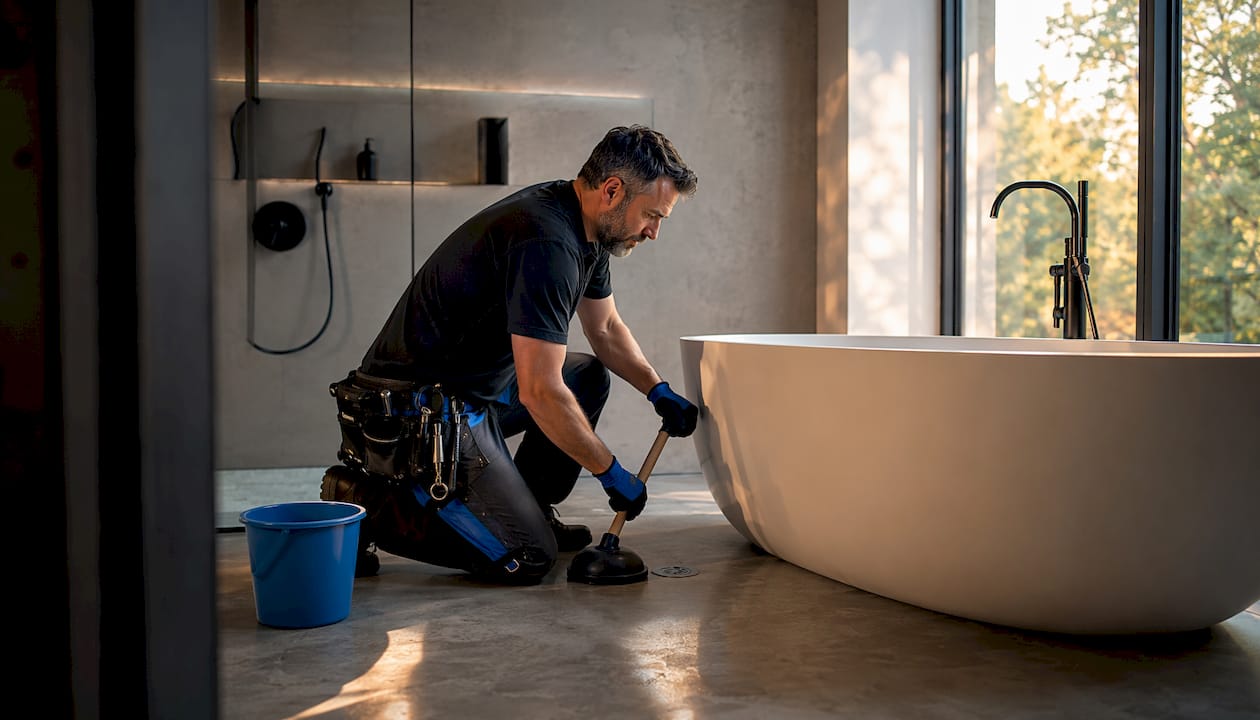
Start with the simplest fix: pull out any visible hair from around the drain opening, then lift and clean the stopper. Those two steps alone clear the majority of slow-draining baths without any tools. If the water still pools, a plunger or a plastic zip tool will handle most of what’s left. A healthy bath should clear standing water within a couple of minutes under normal conditions. If yours is taking significantly longer, something is partially blocking the drain.
Quick safety note: Skip chemical drain cleaners for now. They can damage older metal pipes and are often ineffective against hair-heavy clogs. Stick to mechanical methods first.
Two immediate actions to try right now:
- Put on rubber gloves, remove the stopper, and pull out any hair or gunk you can reach with your fingers or needle-nose pliers.
- Block the overflow plate with a wet cloth, place a cup plunger over the drain, and give it 10–15 firm pumps.
If either step restores normal flow, you’re done. If not, the sections below walk you through every method in safe order.
Table of Contents
- What usually causes a slow draining bath?
- Step-by-step DIY fixes to try, in safe order
- How to remove and clean a pop-up or lever-operated stopper
- How to prevent slow drains going forward
- When should you call a plumber?
- Why hair and soap scum cause more damage than you’d expect
- Key Takeaways
- The fix most homeowners skip
- Persistent drainage issues? Jmplumbingservicesltd can help
- Useful sources and further reading
What usually causes a slow draining bath?
Hair combined with soap scum is the single most common culprit. Together they form a paste-like residue that builds up in the P-trap or around the stopper mechanism. But there are several other causes worth knowing, because the right fix depends on diagnosing the right problem.
Primary causes:
- Hair and soap scum buildup — the most frequent cause; forms a dense, sticky mat just below the drain opening or in the P-trap
- Faulty or clogged stopper mechanism — a pop-up or lever-operated stopper that doesn’t open fully acts as a partial obstruction even when there’s no clog
- Partial pipe clog — debris that has passed the stopper and compacted further down the waste pipe
- Limescale and hard-water deposits — common in many parts of the UK; mineral buildup narrows the pipe bore over time
- Blocked plumbing vent — a partially blocked vent stack reduces the air pressure needed for water to drain freely, causing gurgling and slow flow
- Mainline or shared waste-pipe blockage — when multiple fixtures slow down at once, the problem is almost certainly deeper than the bath drain itself
Diagnostic clues to narrow it down:
- Only the bath is slow — almost certainly a near-drain clog or stopper issue; DIY-solvable in most cases
- Bath and basin are both slow — shared waste pipe is partially blocked; try DIY but be prepared to call a plumber
- Multiple fixtures plus gurgling sounds — mainline blockage; stop DIY attempts and call a professional
- Slow drain only after using heavy conditioners or oils — soap scum buildup is the likely cause; respond with the baking soda and vinegar method
- Drain was fine, then suddenly slowed — check the stopper mechanism first; a mechanical fault is more likely than a new clog
- Sewage smell alongside slow drainage — stagnant organic material fermenting in the trap; act quickly
The good news: the vast majority of single-fixture slow drains are DIY-solvable with tools you likely already own.
Step-by-step DIY fixes to try, in safe order
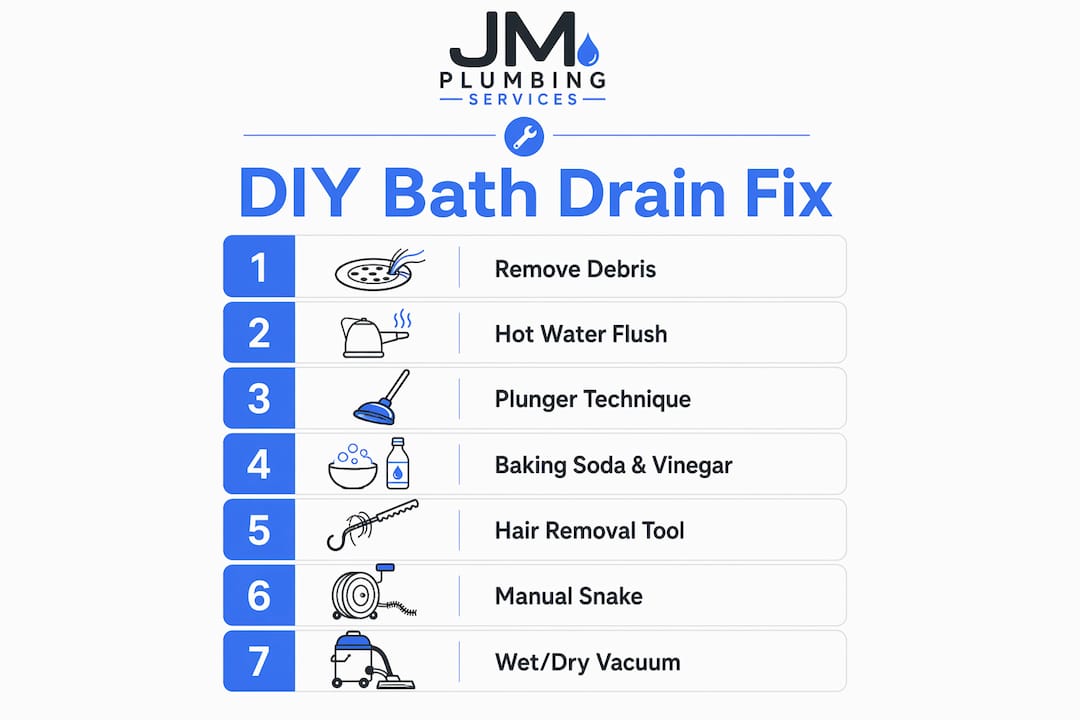
Work through these methods in sequence. Try each one fully before moving to the next, and stop after two failed attempts at any single method rather than pushing harder and risking a deeper compaction.
Tools you’ll need:
- Rubber gloves
- Bucket (to bail standing water if needed)
- Plastic zip/hair removal tool (a barbed plastic strip, widely available for a few pounds)
- Cup plunger
- Wet cloth or rag
- Basic drain auger (optional, for deeper clogs)
- Adjustable spanner (only if removing the stopper requires it)
Method 1: Remove visible debris (always start here)
- Put on rubber gloves.
- Remove the stopper (see the stopper section below for type-specific instructions).
- Use your fingers or needle-nose pliers to pull out all visible hair and gunk.
- Run hot tap water for 30 seconds and check flow.
Time: 5–10 minutes. Solves the problem in a large proportion of cases.
Method 2: Hot water flush
- Boil a kettle and let it cool for two minutes (near-boiling, not rolling boil).
- Slowly pour it down the drain in two or three stages, pausing 30 seconds between each.
- Run the tap and check flow.
Safety warning: Do not pour boiling water directly into plastic (PVC) pipes or acrylic tubs. Very hot water from the tap is safer for plastic pipework. Older cast-iron or ceramic systems can handle near-boiling water without issue.
Time: 5 minutes.
Method 3: Plunger technique
- Block the overflow plate with a wet cloth pressed firmly against it. This is critical — without the seal, pressure escapes and the plunger does nothing.
- Add enough water to the tub to cover the plunger cup.
- Place the cup plunger directly over the drain opening.
- Push down and pull up firmly, 10–15 times.
- Remove the plunger and run the tap to test.
Time: 5–10 minutes.
Method 4: Baking soda and white vinegar
- Pour one cup of bicarbonate of soda (baking soda) directly into the drain.
- Follow immediately with one cup of white vinegar.
- Let the fizzing reaction work for at least 30 minutes, ideally an hour.
- Flush with hot (not boiling) water.
This method works best on soap scum and grease rather than compacted hair. Industry suppliers recommend this combination as a safe, pipe-friendly option for regular maintenance too.
Time: 35–65 minutes including wait time.
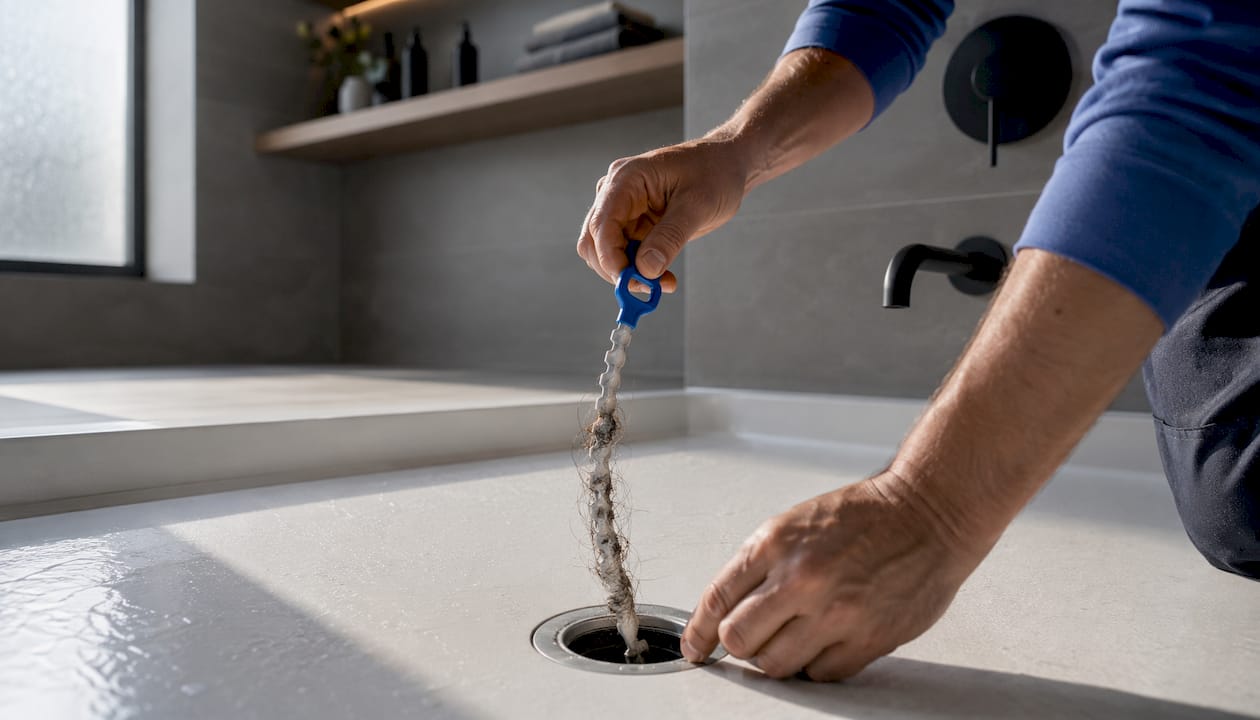
Method 5: Plastic zip/hair removal tool
- Push the barbed plastic strip down the drain as far as it will go.
- Rotate it slightly, then pull back slowly. The barbs grab hair and pull it out.
- Dispose of the debris in the bin, not the toilet.
- Repeat until the tool comes back clean.
- Flush with hot water and test.
Pro Tip: Run the zip tool before trying the plunger. Plunging over a hair clog can push it deeper into the pipe rather than dislodging it.
Time: 10–15 minutes. Highly effective for near-drain hair clogs.
Method 6: Manual drain snake/auger
Use this only after the above methods have failed. Feed the cable down the drain until you feel resistance, tighten the set screw, and rotate the handle clockwise to break up or hook the clog. Pull back slowly. This Old House recommends a hand auger as the last DIY step before calling a professional for deeper blockages.
Time: 15–20 minutes.
Method 7: Wet/dry vacuum
If you have a wet/dry vacuum (a standard household shop vac works), set it to liquid mode, create a tight seal over the drain opening with the hose, and run it for 20–30 seconds. The suction can pull a near-drain clog up and out when other methods haven’t shifted it. It’s less common than the other methods but genuinely useful for stubborn surface blockages.
Time: 5–10 minutes.
How to remove and clean a pop-up or lever-operated stopper
A slow bath is sometimes not a clog at all. A stopper that doesn’t open fully restricts flow just as effectively as debris. Plumbers frequently find that a faulty pop-up stopper or a stuck lever behind the overflow plate is the real culprit.
Common stopper types and their symptoms
Pop-up stopper (lifts and drops with a lever or push): if it doesn’t rise fully when set to “open,” it’s mechanically restricting flow. Often caused by a corroded or misadjusted linkage rod.
Lift-and-turn stopper (you twist and lift it manually): these can seize in a partially closed position. The small set screw underneath can corrode, making removal tricky.
Trip-lever stopper (controlled by a lever on the overflow plate): the plunger inside the overflow pipe can drop too low and partially block the drain even in the “open” position. Debris also collects behind the overflow plate itself.
Step-by-step: removing and cleaning the stopper
- Pop-up and lift-and-turn types: Unscrew the small knob or set screw on top of the stopper (a flathead screwdriver usually does it), then lift the stopper straight out. Clean all soap scum and hair from the stopper body and the drain opening beneath it.
- Trip-lever type: Unscrew the two screws on the overflow plate (the plate above the drain, on the tub wall). Gently pull the entire lever and linkage assembly out through the overflow opening. Clean hair and debris from the linkage rods and the plunger at the end.
- Removing the overflow plate also gives you direct access to the overflow pipe, where hair and soap buildup often collect and cause slow drains that plunging alone won’t fix.
- Soak metal parts in white vinegar for 15–20 minutes to dissolve limescale.
- Reassemble and test flow before replacing the overflow plate.
Pro Tip: If the linkage rod on a trip-lever stopper is seized, a small amount of silicone-based lubricant (not WD-40, which attracts grime) on the pivot points will free it without damaging the finish.
Safety note: Stopper linkages have sharp edges. Work slowly, and keep a small container nearby to hold screws so they don’t fall down the drain. If threads are stripped or the linkage is broken, replacement parts are available from most UK plumbing merchants, but if you’re unsure, stop and call a plumber rather than forcing anything.
How to prevent slow drains going forward
Simple drain screens emptied after each use eliminate the bulk of bath drainage problems for most households. Prevention takes about 30 seconds per bath and costs almost nothing.
Daily and weekly habits:
- Remove visible hair from the drain opening after every bath or shower
- Run hot tap water for 60 seconds after using heavy conditioners, oils, or bath bombs
- Avoid pouring thick conditioners or carrier oils directly down the drain
- Wipe the stopper and drain surround weekly to prevent soap scum from hardening
Products worth buying:
- In-drain hair catcher (a fine-mesh insert that sits inside the drain): catches hair before it reaches the P-trap; empty after every use
- Pop-up strainer (sits over the drain opening): works well with most UK bath fittings and is easy to clean
- Enzyme-based drain maintainer (available at most UK DIY stores and online): monthly use breaks down organic residue without harming pipes; far safer than caustic chemical cleaners for regular maintenance
Monthly maintenance routine:
- Pour one cup of bicarbonate of soda followed by one cup of white vinegar down the drain; leave for 30 minutes, then flush with hot water
- Check the stopper mechanism opens and closes freely
- Inspect the overflow plate for visible buildup
What to avoid: Regular use of caustic chemical drain cleaners (those containing sodium hydroxide or sulphuric acid) on older metal or lead pipes. They can damage the pipework and are often ineffective against hair anyway. For a deep-clean of the whole bathroom alongside drain maintenance, a thorough bathroom deep-clean routine pairs well with monthly drain care.
When should you call a plumber?
Most single-fixture slow drains respond to DIY methods within one or two attempts. When they don’t, pushing further risks making things worse.
Stop DIY and call a plumber if:
- Multiple fixtures (bath, basin, toilet) are draining slowly at the same time
- You hear persistent gurgling from other drains when the bath empties
- Water backs up into the basin or toilet when the bath drains
- There’s a sewage smell that doesn’t clear after cleaning the stopper and trap
- You’ve tried two full rounds of DIY methods and the drain is still slow
- You can see visible pipe corrosion, cracks, or signs of leaking around the waste pipe
- The bath has recurring drainage issues that keep returning within weeks of clearing
Ballpark UK cost ranges:
| Service | Typical Cost Range | Notes |
|---|---|---|
| Plastic zip/hair tool | £3–£10 | One-off purchase, reusable |
| Basic drain auger (DIY) | £15–£40 | Available at UK DIY stores |
| Professional drain clearing | £75–£300 | Depends on complexity and access |
| Emergency call-out | Higher (varies) | Out-of-hours rates apply |
| Camera drain inspection | £200 | Recommended for recurring issues |
What to ask your plumber before they start:
- Will you inspect the full waste run, or just the bath trap?
- Do you carry a drain camera for diagnosis?
- Can you provide a written quote before starting work?
- Is there a guarantee on the repair?
Before the plumber arrives: clear the area around the bath, note which fixtures are affected and when the problem started, and check whether the slow drain appeared suddenly or gradually. That information helps a plumber diagnose faster and quote accurately.
Why hair and soap scum cause more damage than you’d expect
The mechanics of a bath clog are worth understanding, because they explain why early action matters so much more than most people realize.
Hair doesn’t just sit in the drain. It forms a mesh that traps soap scum, skin oils, and mineral deposits, gradually compressing into a dense, paste-like mass in the P-trap or around the stopper linkage. That mass doesn’t dissolve on its own. Over weeks, it compacts further, and the organic material in it begins to ferment.
The practical implication: A small, soft clog you can pull out with a zip tool in five minutes becomes a compacted, odor-producing blockage that may require a professional auger or camera inspection if left for months. Early intervention consistently prevents the more expensive outcome.
Stagnant water sitting above a partial blockage also creates conditions for bacterial growth, which is where the sewage-like smell comes from. Hard water accelerates the problem in many UK regions: mineral deposits bind to the hair-and-scum matrix, making it harder and more resistant to flushing. That’s why a monthly enzyme treatment or bicarbonate-of-soda flush makes a real difference in hard-water areas like Cardiff and the Vale of Glamorgan.
Key Takeaways
Most slow-draining baths are caused by hair and soap scum near the drain and can be cleared in under 30 minutes using a zip tool, plunger, or baking soda flush before any professional help is needed.
| Point | Details |
|---|---|
| Start with the stopper | Remove and clean the stopper first; a mechanical restriction often mimics a clog. |
| Use mechanical methods first | Zip tools and plungers outperform chemical cleaners and are safe for all pipe types. |
| Normal drain time | A healthy bath should clear standing water within 1–2 minutes. |
| Call a plumber at two failures | If two full DIY attempts don’t restore flow, stop and book a professional inspection. |
| Jmplumbingservicesltd | For persistent or multi-fixture drainage problems in Cardiff and the Vale of Glamorgan, Jmplumbingservicesltd provides inspection, camera diagnosis, and repair. |
The fix most homeowners skip
The stopper mechanism is where I’d start every time, and it’s the step most people skip entirely. Homeowners go straight for the chemical cleaner or the plunger, but a trip-lever stopper that’s dropped a centimeter too low in the overflow pipe will slow your bath regardless of how clean the drain is. Pull the overflow plate, check the linkage, and clean behind it before you try anything else. Nine times out of ten, the answer is right there.
The other thing worth saying plainly: two failed DIY attempts is the limit. Not because the methods don’t work, but because pushing a compacted clog deeper with an auger you’re not confident using can turn a £100 professional job into a £300 one. Knowing when to stop is as useful as knowing what to try.
Persistent drainage issues? Jmplumbingservicesltd can help
When DIY methods haven’t cleared the problem, or when multiple fixtures are affected, the issue is almost certainly deeper than a near-drain clog. That’s when a professional inspection pays for itself.
Jmplumbingservicesltd covers Cardiff and the Vale of Glamorgan for exactly these situations: a proper camera-assisted diagnosis, a clear written quote before any work starts, and a repair guarantee on completed jobs. No guesswork about what’s blocking the pipe and no surprise costs after the fact. Whether it’s a compacted waste-pipe blockage, a corroded stopper that needs replacing, or a drainage issue that points toward a bathroom renovation in Cardiff, the team handles it from inspection through to completion.
If you’re in Cardiff, Barry, Penarth, or anywhere across the Vale of Glamorgan and the drain still isn’t clearing, get in touch with Jmplumbingservicesltd for a straightforward quote. Book online or call directly — same-day appointments are available for urgent drainage problems.
Useful sources and further reading
- HomeServe UK: What to do if your bathtub is draining slowly — practical UK-focused advice on causes, DIY methods, and when to call a professional
- This Old House: How to Fix a Slow-Draining Tub — step-by-step method guide from a trusted home improvement authority
- The Spruce: Slow-Draining Bathtub — covers hair and soap scum mechanics and prevention strategies
- Oatey: How to Fix a Slow Draining Bathtub — industry supplier guidance on mechanical removal and safe flushing
- Vidalux: How long does a walk-in bath take to drain? — useful reference for normal drain-time expectations
- Jmplumbingservicesltd: Plumber Cardiff — local professional plumbing services across Cardiff and the Vale of Glamorgan
- Jmplumbingservicesltd: What to Do If You Have a Bathroom Leak — guidance on escalating drainage and leak concerns
- Bathroom Renovation Phases Explained — useful if recurring drainage problems point toward a full bathroom renovation
For emergency plumbers or camera drain inspections in the UK, search “emergency drain unblocking [your town]” or “CCTV drain survey [your area]” to find local specialists. Checkatrade and Trustmark both list vetted UK plumbers with verified reviews.