
Fix a Towel Rail Not Heating: Quick DIY Checks
Is your towel rail not heating? Discover quick DIY checks to restore warmth, ensuring safety and efficient troubleshooting. Get started now!
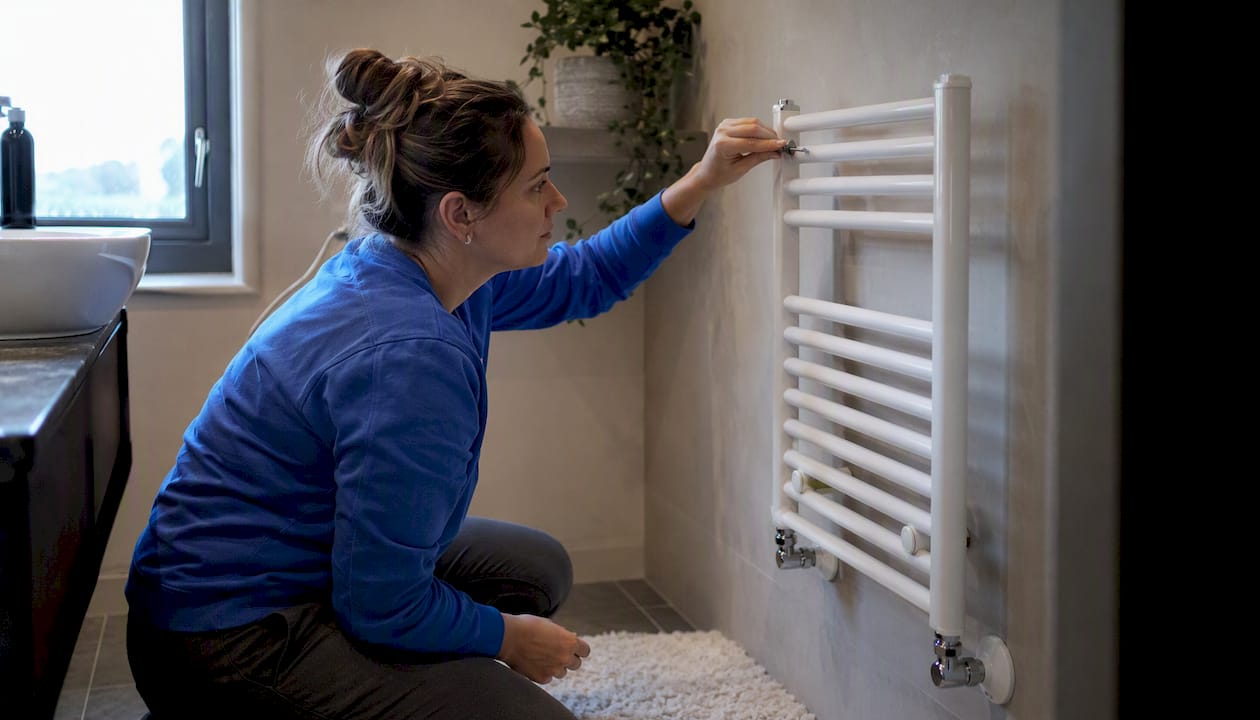
A towel rail not heating usually comes down to one of three things: trapped air in a hydronic rail, a closed or seized valve, or a blown fuse or failed element in an electric model. If your rail runs off the central heating, turn off the boiler and bleed the rail first. If it’s electric, check the fused spur and the RCD in your consumer unit before anything else.
Safety first, always:
- Electric rails: Isolate the power at the fused spur or consumer unit before touching any wiring or the element.
- Hydronic rails: Turn off the central heating and let the rail cool completely before bleeding or adjusting valves.
Pro Tip: Take a photo of your boiler pressure gauge before you start. Bleeding a hydronic rail can drop the pressure enough to trigger a lockout, and you’ll want a baseline to top it back up.
Table of Contents
- How to quickly diagnose your towel rail problem
- Step-by-step checks for an electric towel rail not heating
- Step-by-step checks for a hydronic towel rail not warming up
- Symptom-to-fix map for common towel rail issues
- When you should call a professional instead of DIYing
- Simple maintenance habits that prevent towel rail problems
- Key Takeaways
- The fix most homeowners overlook
- Jmplumbingservicesltd can sort your cold towel rail fast
- Useful sources
How to quickly diagnose your towel rail problem
Before you reach for a radiator key or a multimeter, spend two minutes figuring out what type of rail you have and what it’s actually doing. That single step routes you to the right fix and stops you wasting time on checks that don’t apply.
What type of rail do you have?
- Electric only: Has a cable entering the body or a plug socket nearby, no visible pipework entering the wall at the bottom.
- Hydronic (central heating): Two pipes enter from the wall or floor, usually with a TRV (thermostatic radiator valve) on one side and a lockshield cap on the other.
- Dual-fuel: Has both pipework and an electric element, so it can run off the heating in winter and the element alone in summer.
What is the rail doing?
| Symptom | Likely section to read next |
|---|---|
| Cold all over, other rads are hot | Hydronic checks (valves/balancing) |
| Cold at the top, warm at the bottom | Hydronic checks (bleed) |
| Cold at the bottom, hot at the top | Hydronic checks (sludge) |
| Completely cold, no warm pipes | Electric checks or closed isolation valve |
| Gurgling or bubbling sounds | Hydronic checks (air/pressure) |
Quick rule of thumb: Cold at the top means air — bleed it. Cold at the bottom means sludge — that’s a job for a heating engineer. Cold all over with warm pipes feeding it means a valve is closed or the system is out of balance.
Pro Tip: Run your hand along the feed pipes going into the rail. If they’re warm but the rail is cold, the problem is almost certainly a closed or stuck valve, not the boiler.
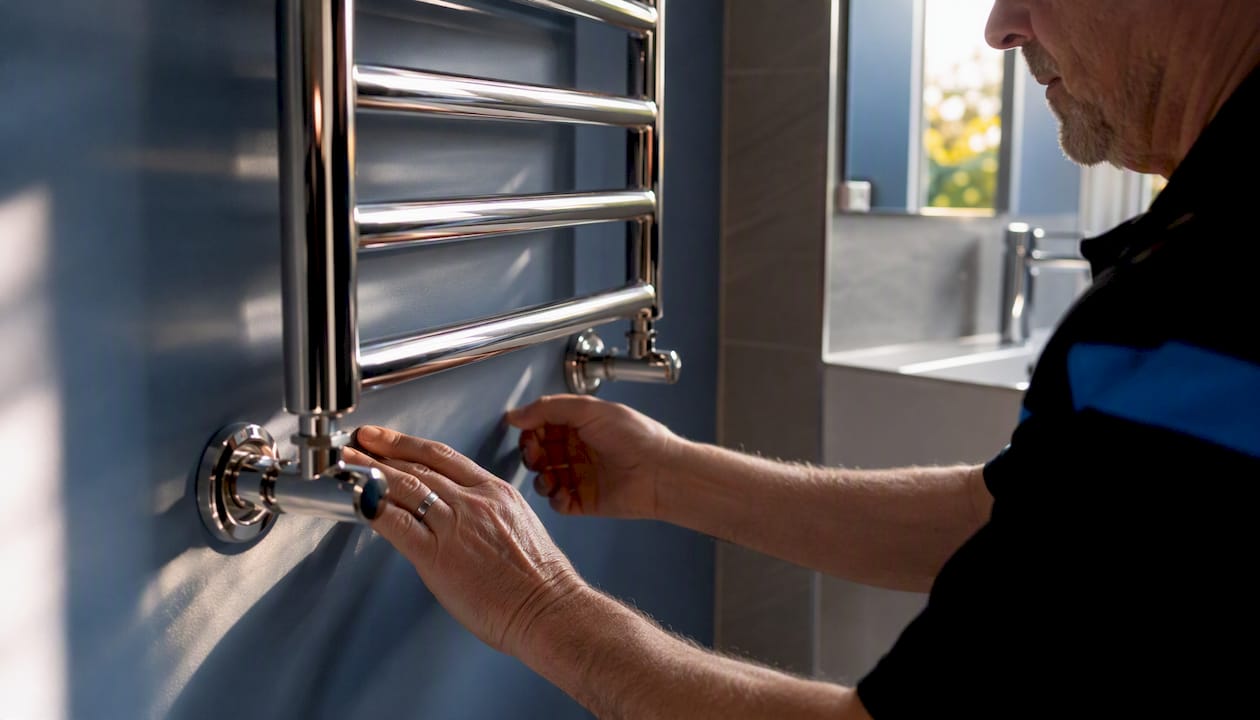
Step-by-step checks for an electric towel rail not heating
Most electric towel rail failures are not the element. According to Elegant Radiators, a blown 3A or 5A fuse in the fused spur or a tripped breaker is the most common culprit, and both are things you can check safely in under five minutes.
- Isolate the power. Switch off at the fused spur (the small switch on the wall near the rail) or at the consumer unit. Never skip this step.
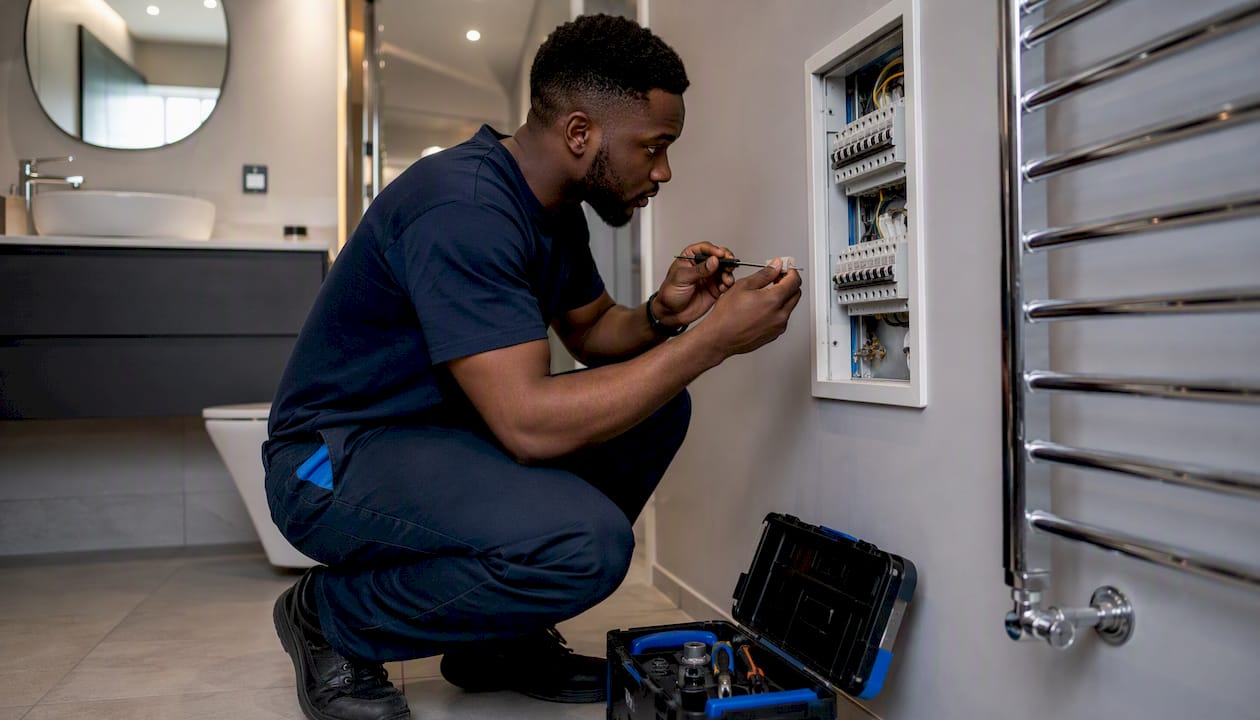
- Check the fused spur. Unscrew the fused spur cover and inspect the cartridge fuse. A 3A or 5A fuse is standard. If it looks blackened or the wire inside is broken, replace it with an identical rating.
- Check the consumer unit. Look for a tripped RCD or MCB. If one has flipped to the off position, reset it. If it trips again immediately, stop and call a qualified electrician.
- Check the thermostat and timer. Many electric rails have a built-in thermostat that cuts out when the room is already warm. Turn the thermostat dial up and confirm the timer is set to an active period. Some timer-driven models need a full power reset: isolate for 60 seconds, then restore.
- Check the isolator switch. Some installations include a separate isolator switch on the wall. Confirm it’s in the on position.
- Test element continuity (advanced). With power fully isolated, a multimeter set to resistance (Ω) can confirm whether the element has continuity. No continuity means the element has failed.
Stop here if: the RCD keeps tripping, you find scorching around the fused spur, or the element shows no continuity. Element replacement and any internal wiring work must be done by a qualified electrician. For similar electrical safety checks on small bathroom fixtures, the guidance on extractor fan troubleshooting follows the same isolation-first principle.
Pro Tip: Before calling an electrician, write down exactly what you found: which fuse blew, whether the RCD tripped, and whether the element showed continuity. That 30-second note can cut your call-out time significantly.
Step-by-step checks for a hydronic towel rail not warming up
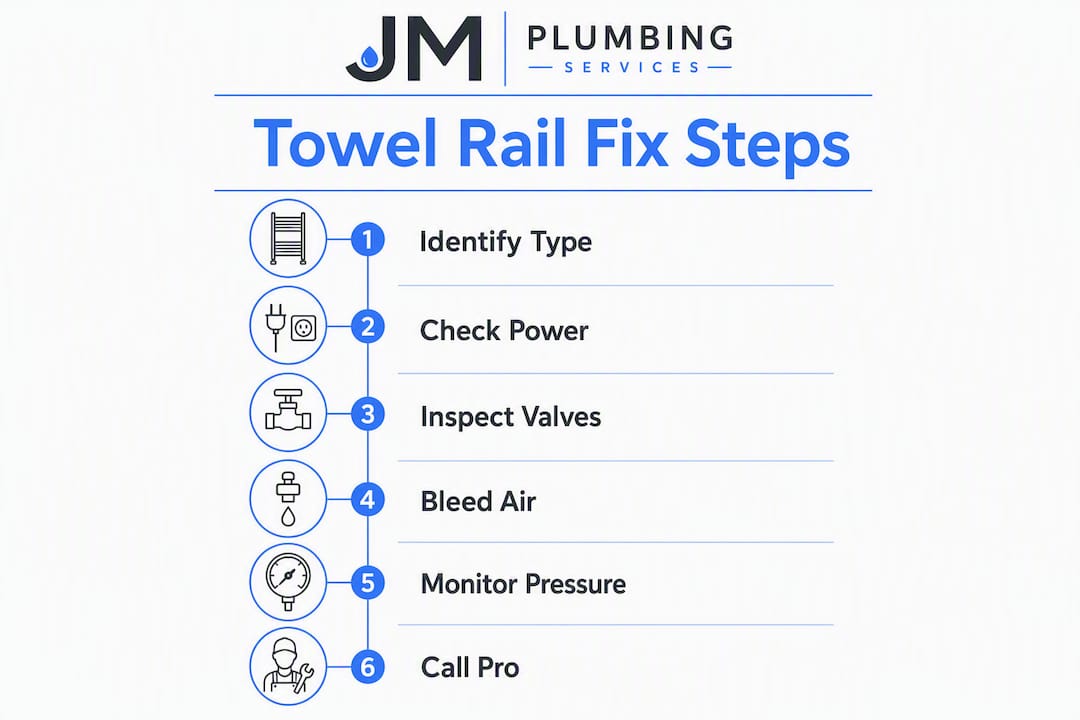
Hydronic towel radiator troubleshooting follows a clear order: bleed first, then check valves, then consider balancing or sludge. Advanced Heating & Plumbing’s guide confirms that bleeding often restores heat within minutes, making it the right first move for a cold-at-the-top rail.
- Turn off the heating and let the rail cool. Hot water under pressure can scald. Give it 20–30 minutes.
- Locate the bleed valve. It’s usually a small square or slotted valve at the top corner of the rail. You’ll need a radiator bleed key or a flat-head screwdriver.
- Bleed the rail. Hold a cloth under the valve, turn it a quarter-turn counterclockwise. You’ll hear a hiss as air escapes. Close the valve as soon as water appears — don’t let it run.
- Check boiler pressure. After bleeding, check your boiler’s pressure gauge. Most combi boilers need 1–1.5 bar. If it’s dropped below that, use the filling loop to top it up before restarting.
- Restart the heating and test. Give the system 15–20 minutes to circulate. If the rail is still cold, move to the valve checks below.
- Check the TRV. The thermostatic radiator valve has a numbered dial. Confirm it’s not set to zero (frost protection only). If it feels stiff or won’t turn, the pin inside may be seized. Remove the plastic head — you’ll see a small metal pin. Gentle tapping or wiggling can free it. TheHomeBit’s troubleshooting guide notes that valves sitting unused through summer are the most common cause of seized pins.
- Check the lockshield valve. Remove the plastic cap on the opposite side of the rail. The lockshield controls flow. If it’s fully closed (turned fully clockwise), open it a quarter-turn and retest.
- Test for a balancing issue. If the rail heats up when you turn other radiators off, the system is out of balance. Axiom Eco Homes explains that adjusting lockshield valves to restrict faster radiators forces more flow to slower ones like towel rails — a process that takes 30–60 minutes and is worth attempting before calling a professional.
Pro Tip: *A visual how-to can help if you’ve never bled a radiator before.
shows the exact technique, including what the hiss sounds like and when to close the valve.*
Symptom-to-fix map for common towel rail issues
| Symptom | Most likely cause | Quickest fix |
|---|---|---|
| Cold all over, other rads warm | Closed valve or isolated rail | Open TRV and lockshield; check isolation valve |
| Hot bottom, cold top | Trapped air | Bleed the rail |
| Hot top, cold bottom | Sludge/magnetite buildup | Call a heating engineer for a powerflush |
| Completely cold, pipes cold too | Airlock or fully closed lockshield | Close other rads, open this one fully, retest |
| Gurgling or bubbling | Trapped air or flow restriction | Bleed and check boiler pressure |
| Electric rail cold all over | Blown fuse or tripped RCD | Check fused spur and consumer unit |
| Electric rail warm but not hot | Thermostat set too low or element degrading | Raise thermostat; test element continuity |
The cold-top vs. cold-bottom distinction matters a lot. Cold at the top is an airlock — you can fix it yourself in ten minutes. CompanyBlue’s guide confirms that sludge settles at the bottom of radiators and restricts lower flow, which is why a hot top with a cold bottom almost always means a powerflush rather than a bleed.
- If the rail is cold but its feed pipes are warm, the fault is local to the rail (valve or airlock), not the boiler.
- If multiple radiators are cold in the same zone, the issue may be a zone valve or pump fault — call a heating engineer.
- If the rail is cold and the boiler is showing a fault code, address the boiler first.
When you should call a professional instead of DIYing
Some faults are genuinely safe to fix yourself. Others aren’t, and the line is worth knowing clearly.
Call a qualified electrician for:
- A failed heating element (no continuity on multimeter test)
- Any internal wiring fault or scorching around the fused spur
- An RCD that keeps tripping after reset
Call a Gas Safe registered heating engineer or plumber for:
- Valve replacement (TRV or lockshield that won’t open or is corroded)
- System rebalancing if the DIY lockshield adjustment doesn’t resolve it
- A powerflush to clear sludge/magnetite buildup
- Any visible leak at the rail connections
- Suspected pump or zone valve failure
| Job | Typical time on site | Approximate UK cost range |
|---|---|---|
| Standard call-out (diagnosis) | 30–60 min | £60 |
| Fused spur fuse replacement | 30 min | £50 |
| Electric element replacement | 1–2 hours | £100 |
| TRV or lockshield replacement | 1 hour | £80 |
| System rebalancing | 1–2 hours | £80 |
| Powerflush (full system) | 4–8 hours | — |
Cost ranges are approximate and vary by region, access, and parts. Always get a written quote before work begins.
Pro Tip: Before calling, note which radiators are affected, whether the problem started suddenly or gradually, and any recent work done on the system. A heating engineer who arrives with that context can diagnose faster and charge less.
For issues that involve water leaks alongside a cold rail, the guidance on leaking shower trays covers the same decision framework: fix it yourself or call a pro.
Simple maintenance habits that prevent towel rail problems
Most towel rail call-outs are preventable. The faults that bring engineers out most often — seized TRV pins, airlocks, and sludge buildup — all respond to basic annual maintenance.
Annual tasks (every autumn before the heating season):
- Bleed all radiators and towel rails; check boiler pressure afterward.
- Exercise TRV pins by turning them from minimum to maximum a few times. TheHomeBit’s guide identifies seasonal inactivity as the main cause of seized pins, and this one step avoids many call-outs.
- Inspect all visible pipe connections for drips or corrosion.
- Check the boiler pressure and top up if it’s below 1 bar.
Mid-term upgrades worth doing:
- Install a magnetic system filter such as a MagnaClean during your next annual service. CompanyBlue recommends fitting one to capture magnetite before it settles in narrow towel rail tubes. The filter is cleaned at each service, not replaced.
- Ask your heating engineer to top up system inhibitor when they service the boiler. Inhibitor slows corrosion and reduces sludge formation.
Summer tips for dual-fuel and hydronic rails:
- For dual-fuel rails, run the electric element occasionally through summer for towel drying. This keeps the element active and avoids the damp buildup that accelerates corrosion.
- For hydronic-only rails, move the TRV dial through its full range once a month during the off-season to prevent pin seizure.
Landlords managing multiple properties should consider scheduling annual boiler servicing alongside radiator maintenance — combining both visits cuts call-out costs and keeps the whole system in check.
Key Takeaways
A towel rail not heating is almost always a localized fault — trapped air, a closed valve, or a blown fuse — not a sign that the boiler or whole system has failed.
| Point | Details |
|---|---|
| Identify the rail type first | Electric, hydronic, or dual-fuel determines which checks to run. |
| Bleed before anything else (hydronic) | Trapped air at the top is the most common cause; bleeding restores heat in minutes. |
| Check fused spur and RCD (electric) | A blown 3A/5A fuse or tripped breaker causes most total electric rail failures. |
| Cold bottom = sludge, not air | Hot top with cold bottom needs a powerflush, not a bleed — don’t waste time on the wrong fix. |
| Jmplumbingservicesltd covers Cardiff and the Vale of Glamorgan | For valve replacements, powerflushing, or full bathroom upgrades, JM Plumbing Services offers local call-outs with transparent quotes. |
The fix most homeowners overlook
Here’s what I see consistently in towel rail troubleshooting advice: everyone focuses on the dramatic faults — failed elements, full powerflushing, boiler problems. The reality is that the majority of cold towel rails come back to life with a bleed key and two minutes of patience, or a TRV pin that just needs to be wiggled free after sitting untouched since April.
The cold-top vs. cold-bottom rule is genuinely useful and almost never mentioned clearly enough. If the top bars are cold and the bottom is warm, you have air. If the bottom is cold and the top is hot, you have sludge. Those two symptoms point to completely different fixes, and confusing them means either wasting time bleeding a rail that needs a flush, or calling an engineer for a job you could have done yourself.
The other thing worth saying plainly: a MagnaClean filter is one of the most cost-effective things you can add to a central heating system. Towel rails have narrow tubes that clog faster than standard radiators, and magnetite buildup is slow enough that most homeowners don’t notice until the rail stops heating entirely. Fitting a filter during a routine service costs a fraction of a powerflush and prevents the problem from recurring.
Jmplumbingservicesltd can sort your cold towel rail fast
When the DIY checks don’t resolve it, or you’d rather have a professional handle it from the start, Jmplumbingservicesltd covers Cardiff and the Vale of Glamorgan with straightforward call-outs for exactly these jobs.
On a call-out for a cold towel rail, the team will check valve operation, bleed the rail if needed, test element continuity on electric models, and advise on balancing or a powerflush if the system needs it. You’ll get a clear diagnosis and a written quote before any work proceeds. No guesswork, no surprise invoices.
To prepare for the visit: make sure the boiler and rail are accessible, note which radiators are affected, and have any recent plumbing work details ready. That speeds up the diagnosis and keeps the visit short.
For local bathroom repairs, radiator servicing, or a full bathroom renovation in Cardiff, get in touch with the team at jmplumbingservicesltd.com to book a visit or request a quote.
Useful sources
The following resources were used in preparing this guide and are worth bookmarking for deeper how-to detail or official safety guidance.
- Advanced Heating & Plumbing: Towel Rail Not Heating — Step-by-Step Fix Guide — detailed bleeding procedure with video; the most practical single resource for hydronic rail checks.
- TheHomeBit: How To Solve Common Problems With Heated Towel Rails — covers TRV pin seizure and seasonal maintenance in plain language.
- Axiom Eco Homes: Towel Rail Cold When Heating Is On — best available guide on lockshield balancing and the isolate-and-test method.
- CompanyBlue: Why Is My Towel Rail Not Heating Up? 7 Common Reasons — clear explanation of sludge vs. airlock symptoms and when to call for a powerflush.
- Elegant Radiators: Towel Rail Radiator Not Heating Up — 7 Causes and Fixes — electric rail checks including fused spur, RCD, and element testing.
- Elegant Heat: Electric Towel Rail Not Heating — Troubleshooting Guide — quick diagnostic checklist for electric-only models.
- YouTube: How To Bleed a Towel Rail Radiator (UK) — short visual demo of the bleeding process for readers who prefer to see the technique.
- GBT100 Heated Towel Rail Timer Operating Instructions — manufacturer reset and safety procedures for timer-driven electric rails.
For local professional help in Cardiff and the Vale of Glamorgan: contact Jmplumbingservicesltd for valve work, powerflushing, electric element replacement, or a full bathroom upgrade. Transparent quotes, local response.